How-To Create the Ultimate Hummingbird Habitat For Your Yard
Key Takeaways
-
Use a mix of native plants and feeders to attract and keep hummingbirds.
-
Choose bright, tubular flowers like bee balm, salvia, and cardinal flower.
-
Keep feeders clean and refill nectar every few days, especially in warm weather.
-
Plant native species to support insects—an essential protein source.
-
Create a layered habitat with flowers, perches, and shelter for long-term visits.
If you want hummingbirds to truly become part of your daily life—not just quick flashes at a feeder—you have to give them a reason to stay.
A feeder can bring them in. But a well-designed habitat turns your backyard, patio, or small side yard into territory. Once a hummingbird claims your space, everything changes. Visits become frequent. Behavior becomes predictable. Your chances of calm, close observation go way up.
This chapter is about building that kind of space.
Not complicated. Not expensive. Just intentional and tuned to how hummingbirds actually live.
Think Like a Hummingbird
Before you plant anything or hang a feeder, it helps to ask a simple question:
“If I were a hummingbird, would I want to live here?”
Hummingbirds are not wandering aimlessly. They’re constantly balancing three needs:
-
Reliable nectar sources – flowers and feeders that provide enough energy.
-
Safe perches and resting spots – places to sit, watch, and conserve energy.
-
Clear visibility to defend territory – open sightlines to detect threats and rivals.
That last one surprises people. A yard that’s too dense and cluttered can feel unsafe to a hummingbird. They want structure—but not chaos.
Your job is to combine those three needs in a way that also feels good for you to sit in. When you do, your yard stops being a place hummingbirds pass through and starts being part of their daily circuit.
Start with Native Plants: The Foundation of Habitat
If you only make one change to your yard, let it be this: plant more native flowers.
Native plants:
-
Produce nectar tuned to your local conditions.
-
Support tiny insects hummingbirds rely on for protein.
-
Handle your climate with less fuss, fertilizer, and water.
You don’t need dozens of species. A small, well-chosen group that blooms across the season is more effective than a random mix.
Focus on three traits:
-
Tubular flowers – especially red, orange, pink, and rich purple.
-
Staggered bloom times – so something is always in flower.
-
Clusters instead of singles – birds are drawn to strong visual targets.
Think in terms of a “nectar calendar” rather than a plant list.
For example, in a Midwest yard like Ohio, a simple sequence could be:
-
Spring: Columbine
-
Early summer: Bee balm
-
Mid–late summer: Cardinal flower and salvia
-
Late season: Native honeysuckle or late-blooming salvia
You can build a similar sequence for any region by asking: “What blooms early, what carries the middle, and what finishes the season strong?”
Hummingbird Resource:
The Best Native Plants To Attract Hummingbirds In Your Area – Turn your yard into a hummingbird haven that actually fits your climate, not just glossy catalog pictures. This guide walks you through the best native plants by region—Northeast, Southeast, Midwest, Southwest, Pacific Northwest, and Rockies—so you can pick flowers, shrubs, vines, and even cacti that thrive where you live and keep hummingbirds fed from early spring to fall. You’ll see specific plant names, bloom times, and simple planting tips, plus ideas for layering heights and colors, so you can build a low‑maintenance, wildlife‑friendly garden that brings hummingbirds back year after year instead of struggling with thirsty, high‑care imports.
Regional Examples (So You Can Picture It)
Here’s how a very simple three- or four-plant core can look in different regions. Adjust specific species to your local native plant lists, but notice the pattern: early, mid, late.
-
Northeast / Upper Midwest
-
Spring: Columbine
-
Early–mid summer: Bee balm, penstemon
-
Late summer: Cardinal flower, salvia
-
-
Southeast
-
Spring: Coral honeysuckle
-
Summer: Salvia, bee balm, turk’s cap
-
Late: Anise salvia, late-blooming native perennials
-
-
Southwest / Mountain West
-
Spring: Penstemon species
-
Summer: Agastache, red yucca
-
Late: Late-flowering salvia, desert-friendly tubular blooms
-
-
West Coast
-
Spring: Native currants, fuchsia-flowered gooseberry
-
Summer: Salvia, penstemon
-
Late: California fuchsia, late salvias
-
This doesn’t replace a full regional or state-level guide, but it gives you a mental model: a small “team” of plants instead of a chaotic collection.
Resource:
Hummingbird Gardening Guide for All 50 States– Discover exactly when to feed and how to garden for hummingbirds in every U.S. state. Click your state for feeder dates, native plants, and visiting species.
Layer Your Space: Vertical Habitat
A flat yard is easy for us to mow, but it’s not very interesting for wildlife.
Hummingbirds respond best to layered environments where different heights serve different purposes.
Think in three layers:
-
Low layer: Groundcovers, low perennials, small flowering plants.
-
Mid layer: Shrubs, larger perennials, dense flower patches.
-
Upper layer: Small trees, tall branches, and intentional perches.
Each layer supports a different part of hummingbird life:
-
Low and mid layers provide nectar and insects.
-
Upper layers provide vantage points and safety.
You can create layering even in a very small yard:
-
Put taller flowers (like bee balm or salvia) behind lower ones.
-
Use a flowering shrub or small tree near your viewing area.
-
Leave a few exposed branches instead of pruning everything down.
Hummingbirds will often feed at flower level, then zip up instantly to a favorite perch. Watch for those patterns—they tell you your layering is working.
Perches: The Overlooked Secret
Perches are one of the simplest, most powerful ways to increase what you see.
Hummingbirds spend a surprising amount of time sitting. They:
-
Guard feeders and flower patches.
-
Rest between feeding bouts.
-
Watch for rivals and threats.
If you’ve ever noticed a hummingbird returning to the same bare twig over and over, that’s not random. That’s a chosen lookout point.
You can support this by:
-
Leaving a few bare twigs or thin branches near feeders or flower beds.
-
Adding a simple branch or stake in a pot close to your viewing area.
-
Avoiding “over-grooming” your shrubs; let some natural structure remain.

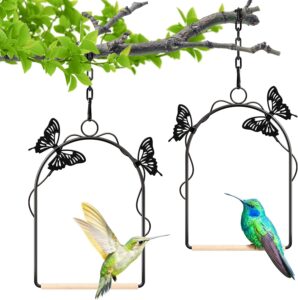
A well-placed perch within your line of sight can turn an occasional glimpse into repeated, predictable viewing throughout a session.
A simple hummingbird swing or decorative perch placed a few feet from your feeder brings birds into perfect view and gives them a “guard post. Once birds adopt a swing or perch, they often stay in the yard longer and make more frequent, relaxed visits. Click on the link above to see a great selection of perches and swings.
Use Feeders Strategically, Not Randomly
Feeders are part of habitat, not a substitute for it.
They’re most effective when they complement your plants and viewing space.
Consider:
-
Placement: Don’t hang a feeder far off in a random corner. Place it where hummingbirds naturally travel—near your core planting and within your own line of sight.
-
Height: Eye level or slightly above makes it easy for you to watch and for birds to approach.
-
Background: A simple, contrasting backdrop (fence, shrub, open space) helps you see birds clearly.
If your goal is calm observation, position at least one feeder within about 6–10 feet of your seat. That distance is close enough for detail, far enough that most birds still feel comfortable.
You can always add a second, more “distant” feeder elsewhere to reduce fighting and give shyer birds another option.
Hummingbird Resource:
Here’s a great article that tells everything you need to know about how to choose the best place to hang your hummingbird feeder
Design from the Seat Out, Not Yard In
Most people design their yard while standing and walking around.
If you want a hummingbird habitat that supports stillness, reverse that.
-
Sit in the place you’d most like to watch from.
-
Notice what’s directly in front of you, to the sides, and in the background.
-
Ask: “If this chair never moved, how could I make this specific view the most compelling?”
From that anchor point, you can:
-
Frame your feeder with flowers behind or around it.
-
Ensure perches are visible from your seat.
-
Remove or soften distracting elements in the background.
This approach prevents you from scattering “interesting things” everywhere and instead creates one clear, compelling focus where the action naturally happens.
Reduce Visual Noise (For You and the Birds)
Your brain and a hummingbird’s brain both benefit from clean, uncluttered space.
Common visual noise includes:
-
Too many ornaments, signs, or miscellaneous decor.
-
Mismatched containers, piles of tools, or storage items.
-
Busy backgrounds—stark fences, cluttered shelves, tangled objects.
You don’t need a minimalist yard. You just want your main viewing corridor to feel simple.
When you sit in your chosen spot, your eye should naturally settle on:
-
The feeder.
-
The surrounding flowers.
-
The open air where hummingbirds move.
Everything else should fade into the background. The more visually calm your focal area is, the easier it is to notice subtle movement—and the less mentally restless you’ll feel.
Light and Sun: Designing for Activity and Comfort
Light shapes hummingbird behavior and your experience.
You’re aiming for a balance that:
-
Gives hummingbirds enough sun for warmth and visibility.
-
Gives you enough comfort to stay seated.
-
Makes the birds easy and enjoyable to see.
Some practical guidelines:
-
Morning light: Soft, warm, and often ideal for both birds and people. If possible, place your main feeder where it catches morning sun.
-
Midday: In hotter climates, lean on partial shade or dappled light. Nectar spoils faster in direct sun, and you won’t want to sit in full heat.
-
Evening light: Golden-hour light can make gorgets (throat feathers) flash brilliantly. Position feeders so you can catch those angles when the sun is low.
Watch how light moves across your yard over a day. If you notice that a certain spot looks especially beautiful or comfortable for 30–60 minutes at a time, that’s often the ideal place to build your habitat focus.
Water: The Finishing Touch That Changes Everything
Most people associate birdbaths with robins or sparrows, not hummingbirds. But hummingbirds are drawn to moving water, especially light, misty, or dripping water.
They may bathe in:
-
A fine mist from a hose attachment.
-
Droplets cascading off leaves.
-
Very shallow flowing water.
You don’t need a big fountain. Simple options include:
-
A small mister aimed at a leafy shrub or branch.
-
A dripper that lets water fall over foliage or stones.
-
A shallow dish with a gentle recirculating pump, set so the water barely ripples.
Place water where:
-
It’s partially shaded (cool, inviting).
-
There’s nearby perching.
-
You can see it from your anchor point.
Once hummingbirds discover a reliable water source, they may visit repeatedly—not just to drink, but to flick through mist, fan their wings, and preen. Those moments are some of the most memorable to watch.
Consider adding a mister. Most people focus on feeders and flowers, but the right water feature can turn your yard into a true hummingbird hangout.
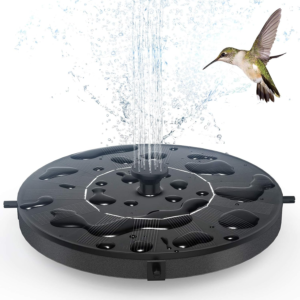
You can also install a shallow birdbath with gently sloping edges with gently sloping edges—no more than about an inch of water—gives hummingbirds a place to sip and splash at the edge. Position water features near, but not directly over, key flower beds so birds can move easily between bathing and feeding.
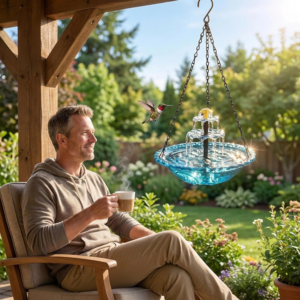
Hummingbird Resource:
How to Use Water Features to Attract Hummingbirds– Unlike many backyard birds, hummingbirds get much of their hydration from nectar and tree sap, so they rarely drink from traditional, deep birdbaths. Instead, they mostly use water to bathe, keep feathers in top condition, and stay cool in hot weather. Here’s a guide to using the correct water features to attract hummingbirds to your garden.
Keep It Healthy: Pesticide-Free and Bird-Safe
Habitat is only as good as it is safe.
To truly support hummingbirds:
-
Avoid pesticides and systemic insecticides on your plants. Those chemicals can affect the tiny insects hummingbirds eat and, in some cases, the nectar itself.
-
Favor hand-weeding, mulching, and natural methods over broad chemical sprays.
-
Keep feeders clean and nectar fresh; a “beautiful” yard doesn’t help much if the feeder becomes a health risk.
Remember: you’re creating a place where a small, high-metabolism bird will feed many times a day. Small exposures add up.
Hummingbird Resource:
My article Natural Pest Control Methods for Your Hummingbird Garden shows readers they don’t have to choose between a healthy hummingbird garden and effective pest control. It explains exactly how to prevent and manage pests using natural methods—companion planting, encouraging “good bugs,” organic sprays like garlic, pepper, and neem, physical barriers, and smart traps—so they protect their plants without poisoning hummingbirds or the insects they eat.
It also gives clear, season‑by‑season checklists and safety tips (like where not to spray, how to avoid harming pollinators, and how to keep pest control away from nests and feeders), making it easy to follow even if you’re new to organic gardening. If you want fewer pests, stronger plants, and a garden that’s truly safe for hummingbirds from spring through fall, this is the article for you!
A Simple “Starter Design” You Can Build This Month
To make this concrete, here’s an example of a simple, scalable hummingbird habitat that works in many backyards:
-
One comfortable chair or bench in a spot with morning or late-afternoon light.
-
One main feeder 6–10 feet away, at eye level, with a contrasting background.
-
A cluster of 3–5 nectar-rich perennials within a few feet of the feeder.
-
One small shrub or small tree with at least one thin, exposed branch visible from your seat.
-
Optional: a mister or small dripper set up on a timer near the shrub.
That’s it.
You can build this foundation in a weekend and refine it over a season.
As you learn how hummingbirds move through that space, you can layer in more plants, add a second feeder farther out, or enhance privacy and comfort around your seating.
What to Expect as Habitat Matures
The first season may feel like a test.
You’ll see:
-
Birds passing through more often as flowering intensifies.
-
A “favorite perch” emerging, often one you didn’t plan for.
-
Feeding patterns stabilizing as certain plants hit their stride.
In later seasons, as perennials establish and shrubs fill in, things tend to snowball:
-
More flowers = more nectar = more frequent visits.
-
Proper structure = more perches = more visible resting behavior.
-
More consistency from you = more predictable hummingbird routines.
The habitat becomes less like a project and more like a living, changing presence that you’re part of and familiar with.
Habitat for You, Too
It’s easy to think of all this as being “for the birds.”
But an overlooked truth is that you’re also creating habitat for yourself.
You’re shaping:
-
A place where you can sit without feeling exposed.
-
A view that rewards stillness rather than constant motion.
-
An environment that draws your attention gently outward, again and again.
When habitat works, it works in both directions.
The hummingbirds get food, shelter, and structure.
You get a place that feels alive, calming, and worth returning to.
FAQ Section
What is the fastest way to attract hummingbirds?
Start with a clean feeder filled with fresh nectar and add bright, nectar-rich flowers to give them a reason to stay.
Why are native plants important for hummingbirds?
Native plants produce more natural nectar and support insects, which provide essential protein for hummingbirds.
Where should I place a hummingbird feeder?
Place feeders near flowers, in partial shade, and where they’re easy to clean and refill regularly.
Do hummingbirds need more than nectar to survive?
Yes, they also eat small insects and spiders for protein, which is why a healthy garden ecosystem matters.