Hummingbirds in Minnesota: When They Arrive, Feeders, and Native Plants
Key takeaways for Minnesota hummingbirds
-
Ruby‑throated Hummingbird is the only common hummingbird in Minnesota; Rufous and other western species are rare visitors.
-
First Ruby‑throats usually arrive in early to mid‑May, with peak activity from late May through August.
-
Most hummingbirds leave between late August and mid‑September; keep at least one feeder up into late September for stragglers and rarities.
-
Simple 4‑to‑1 sugar‑water nectar in easy‑to‑clean feeders, plus regular cleaning, keeps birds healthy and makes the most of the short Minnesota season.
-
Layered plantings with natives like columbine, bee balm, blazing star, penstemon, and lobelias provide nectar, insects, and cover from spring through fall.
Minnesota sits near the northern edge of Ruby‑throated Hummingbird country, so their return is a real sign that winter is finally over. Ruby‑throated Hummingbirds are the only hummingbirds that regularly breed in Minnesota and the species most backyard birdwatchers will see. They move into the state in May, nest across much of the eastern and northern forests as well as wooded neighborhoods, then head south again by early fall. A few western hummingbirds have also been recorded as rarities, so every once in a while a Minnesota feeder hosts something more unusual than a Ruby‑throat.
What hummingbirds do you get in Minnesota?
Ruby‑throated
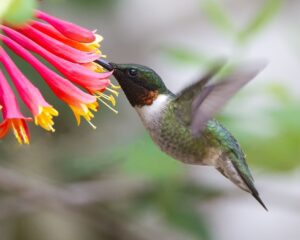
Hummingbird is Minnesota’s common, regular hummingbird. It’s the smallest breeding bird in the state and the only species that routinely migrates through or nests there, making identification easier for beginners. Adult males have the flashy ruby‑red throat and forked dark tail, while females and juveniles are green above with whitish underparts and no red gorget.
Western species like Rufous Hummingbird show up only as rare
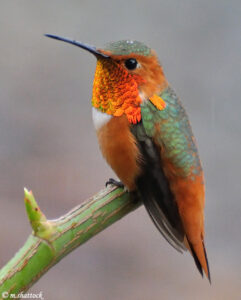
visitors. Birders have documented individual Rufous Hummingbirds that lingered at Minnesota feeders in fall and caused quite a local stir. These vagrants are exciting to see, but they are exceptions; nearly all hummingbirds most Minnesotans see in their yards will be Ruby‑throats.
-
Common, regular species: Ruby‑throated Hummingbird (only regular breeder and migrant).
-
Rare visitors: Rufous Hummingbird, plus very occasional other western species, mostly in late fall.
When do hummingbirds arrive and leave Minnesota?
Ruby‑throated Hummingbirds reach Minnesota later than they do in more southern states because they wait for warmer weather and blooming plants. Migration maps and regional articles show first arrivals in southern Minnesota around early to mid‑May, with birds appearing in the northern part of the state a bit later in May. They are typically absent in winter, with only an isolated winter record on the Minnesota Breeding Bird Atlas.
Peak hummingbird activity in Minnesota runs from late May through August, when birds are nesting and raising young. Most Ruby‑throats depart the state between late August and mid‑September, heading for wintering grounds in the southern U.S., Mexico, and Central America. A few may linger into late September, and rare western species can appear at feeders during fall migration.
-
First arrivals: early to mid‑May in most of Minnesota.
-
Peak season: late May through August.
-
Most leave: late August to mid‑September.
When should you put out hummingbird feeders in Minnesota?
Because Minnesota is far north in the Ruby‑throat’s range, residents don’t need feeders out as early as people in southern states, but it still helps to be ready before the first migrants appear. National timing guides suggest having feeders up about one to two weeks before your expected first arrival date, which for northern states often falls in May. For Minnesota, that means putting out at least one feeder in late April to very early May so early birds can refuel as soon as they arrive.
-
Hang feeders by the last week of April or very early May so they’re ready for the first Ruby‑throats.
When should you take feeders down?
Minnesota hummingbirds leave relatively early compared with more southern states. Many Ruby‑throats start heading south in late August, and most are gone by mid‑September. Migration is driven by changing day length and internal changes, not by whether feeders are out, so keeping feeders up a bit longer will not make birds “stay too long.”
-
Keep feeders up through mid‑September in most of Minnesota.
-
If people want to help late migrants (or watch for rare western hummingbirds), leave at least one feeder up into late September and taking it down after no hummingbirds have visited for about two weeks.
Best hummingbird nectar recipe
The best nectar recipe for Minnesota is the same simple mix you recommend everywhere: 1 part plain white sugar to 4 parts water. Boil the water, stir in the sugar until it dissolves, let it cool, then fill clean feeders. There’s no need to add red dye—expert groups emphasize that clear nectar in a feeder with red parts is all hummingbirds need and avoids unnecessary additives.
Remember to:
-
Clean feeders with hot water (and, if needed, a bit of vinegar) every few days in cooler weather and every 1–2 days during hot spells.
-
Throw away cloudy or moldy nectar immediately and refill with a fresh batch.
Where to hang feeders in Minnesota yards
From Twin Cities suburbs to northern cabins, the same placement basics apply. Put feeders:
-
Near flowers, shrubs, or small trees so hummingbirds have perches and quick escape routes.
-
About 4–5 feet off the ground, where birds feel safe but you can easily reach the feeders.
-
A few feet away from large windows, or use decals/screens, to reduce collisions.
Because Minnesota can be windy and stormy, especially around open fields and lakes, suggest hanging feeders where they’re somewhat sheltered so they don’t swing in strong winds. Adding a few thin branches, wires, or swings near feeders gives hummingbirds comfortable perches for resting and watching over “their” feeding stations.
Creating a hummingbird‑friendly yard in Minnesota
Here’s how to turn a typical Minnesota yard into true hummingbird habitat, with the right mix of flowers, feeders, perches, and water so Ruby‑throated Hummingbirds feel safe enough to visit often and stay longer.
Plant layers of native vegetation
Combine small trees, shrubs, vines, and flowering perennials to create a tiered garden with cover and perches at different heights. Whenever possible, choose locally native plants, which support more insects and spiders for hummingbirds to eat and provide the flower shapes they evolved with.
Layered planting example for a Minnesota suburban yard
In a typical Minnesota suburban yard around the Twin Cities or other towns, you can use a simple layered bed along a fence or house wall to keep Ruby‑throated Hummingbirds coming back all season. In the back row, plant taller perennials like blazing star (Liatris spp.), tall garden phlox, and other sun‑loving spikes to give height and late‑season color. In front of these, add mid‑height bee balm (Monarda), salvias, and penstemon so flowers overlap in early and mid‑summer. Along the front edge and near paths or patios, tuck in clumps of wild columbine (Aquilegia canadensis) and other low spring‑bloomers to provide nectar as soon as hummingbirds arrive in May. This kind of “three‑layer” border fits easily into a standard lawn‑plus‑foundation‑planting yard and creates a clear route hummingbirds can follow between flowers and feeders.
Planting ideas for Minnesota cabins and wooded lots
At cabins and wooded lots in northern or central Minnesota, you can lean more on woodland edges and natural clearings. Along the sunny edge of the woods or a driveway, use taller perennials like blazing star and lobelias in the back, with bee balm, columbine, and foxglove‑type flowers in the middle layer where they get dappled sun. Near seating areas, fire pits, or paths, group a few hummingbird‑friendly plants and place your feeders where birds can move easily between the trees, flowers, and a few well‑placed perches. This turns a typical Minnesota cabin clearing into a natural hummingbird corridor without fighting the surrounding trees and shade.
Plan for blooms from spring through fall
Include early, mid‑season, and late‑blooming plants so something is always flowering when hummingbirds are present in Minnesota. Plant in groups or drifts rather than single plants so hummingbirds can feed efficiently and find flowers more easily.
My special guide, The Art of Attracting Hummingbirds to Your Yard, gives you ready‑made lists of hummingbird‑attracting plants that bloom in spring, summer, and fall. It makes it simple to choose plants that keep nectar available from the time the first hummingbirds arrive until the last migrants leave in the fall, with suggestions for both sun and shade so you can match your own Minnesota growing conditions.
Use feeders to supplement, not replace, flowers
Feeders provide a reliable nectar source alongside your plants, especially in early spring and late summer when wild blooms may be sparse because of drought or temperature swings. Hang them where they’re visible from your best flower beds so hummingbirds can move naturally between blossoms and sugar water.
Here is my favorite feeder and why I recommend this feeder: HummZinger Ultra 12‑oz Saucer Feeder.
If you’re tired of leaky bottle feeders and constant insect problems, this video explains why a simple saucer‑style Aspects feeder is my go‑to choice. You’ll see how the low, shallow 12‑ounce bowl helps you mix only what your hummingbirds can use before it spoils, while the built‑in ant moat, raised ports, and included Nectar‑Guard tips work together to keep ants, bees, and wasps out of the nectar. The drip‑proof design and twist‑off cover make cleaning and refilling quick and easy, so it’s realistic to keep nectar fresh even in warm weather. Made from tough, UV‑stabilized polycarbonate in the USA and backed by a true lifetime guarantee, this is a “buy it once” feeder you can count on year after year
Provide safe perches and nesting cover
Keep some shrubs, small deciduous trees, and a few dead or thin branches where hummingbirds can rest, display, and build nests. Avoid pruning everything into neat, bare shapes; a slightly softer outline with twiggy tips gives birds more places to sit.
A hummingbird perch or swing is an easy way
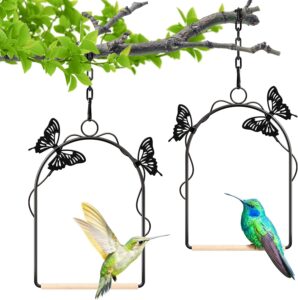
to bring hummingbirds to a particular spot near your feeder. Hummingbirds may look like they’re always in motion, but they actually spend a surprising amount of time sitting still between feeding bouts, using perches to rest, preen, digest nectar, and keep watch over their favorite food sources. A simple swing or decorative perch placed a few feet from your feeder gives them a comfortable “guard post” and brings them right into view where you can enjoy them up close. Many people find that once birds adopt a swing as their regular lookout perch, they stay in the yard longer and make more frequent, relaxed visits.
Offer water in a way hummingbirds like
Most people focus on feeders and flowers, but the right water feature can turn your yard into a hummingbird hangout. Hummingbirds prefer shallow, moving water—fine sprays, mists, and droplets on leaves—over deep, still birdbaths. Add a mister, dripper, or fine spray so hummingbirds can bathe in moving droplets on leaves or in a shallow basin.
Consider adding a mister to create a gentle cloud of moving water; 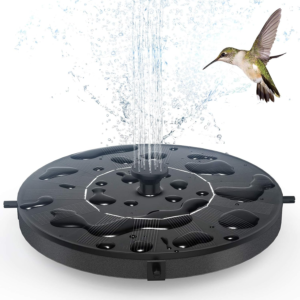 hummingbirds often fly back and forth through the mist, spreading their wings and tails to bathe without getting waterlogged. Place misters near shrubs or small trees so the droplets collect on leaves, giving birds multiple places to sip and bathe.
You can also install a shallow bi rdbath with gently sloping edges—aim for no more than about an inch of water—so hummingbirds can stand safely at the edge or in very shallow water while they drink or splash.
Position water features near, but not directly over, key flower beds so birds can move easily between bathing and feeding.
My detailed guide, How to Use Water Features to Attract Hummingbirds, walks you through the exact kinds of misters, drippers, and shallow baths hummingbirds prefer, how deep and how strong the water flow should be, where to place everything so birds feel safe, and how to keep it all clean without spending a lot of money.
Skip pesticides and let insects thrive
-
Avoid or greatly limit pesticides, especially systemic insecticides, because hummingbirds and their chicks rely heavily on tiny insects and spiders for protein.
- A healthy, chemical‑free yard with native plants will naturally support more insects, which means more high‑quality food for hummingbirds.
This article shows readers they don’t have to choose between a healthy hummingbird garden and effective pest control. It explains exactly how to prevent and manage pests using natural methods—companion planting, encouraging “good bugs,” organic sprays like garlic, pepper, and neem, physical barriers, and smart traps—so they protect their plants without poisoning hummingbirds or the insects they eat. It also gives clear, season‑by‑season checklists and safety tips (like where not to spray, how to avoid harming pollinators, and how to keep pest control away from nests and feeders), making it easy to follow even if you’re new to organic gardening. If you want fewer pests, stronger plants, and a garden that’s truly safe for hummingbirds from spring through fall, you can learn more here: Natural Pest Control Methods for Your Hummingbird Garden
Keep Insects Away From Your Feeder
- Bees, wasps, and ant trails can quickly take over a hummingbird feeder, but you don’t have to give up and bring the feeder in. This guide walks you through the safest, most effective ways to keep pests out of your nectar—using ant moats, bee‑resistant feeders, smarter placement, and even “decoy” feeders that draw insects away—so the sugar water stays clean and available for hummingbirds only. If you’re tired of fighting swarms on your feeders and want a simple plan that actually works, you can learn more here: How to Keep Bees and Ants Away From Your Hummingbird Feeder
FAQ section (onsite text)
-
What hummingbirds live in Minnesota?
Ruby‑throated Hummingbirds are the only hummingbirds that commonly live in and migrate through Minnesota. Other species, such as Rufous Hummingbird, have been recorded only as rare visitors at feeders.
-
When do hummingbirds arrive in Minnesota?
Ruby‑throated Hummingbirds usually arrive in Minnesota in early to mid‑May, with birds appearing first in the southern part of the state and a bit later farther north. -
When should I put out hummingbird feeders in Minnesota?
Put at least one feeder out by late April or very early May so it’s ready when the first migrants arrive. -
When do hummingbirds leave Minnesota?
Most Ruby‑throated Hummingbirds leave Minnesota between late August and mid‑September. A few may linger into late September, and rare western hummingbirds sometimes appear at fall feeders. -
Should I leave my feeders up in the fall?
Yes. Leaving at least one feeder up into late September will not keep hummingbirds from migrating and can help late migrants and rare visitors. -
What is the best hummingbird nectar recipe?
Use 1 part plain white sugar to 4 parts water, boiled and then cooled before filling feeders. Do not add red dye; clear nectar in a red‑accented feeder is all you need. -
Which native plants attract hummingbirds in Minnesota?
Great options include wild columbine, bee balm, penstemon, blazing stars, and lobelias, along with other tubular, nectar‑rich flowers recommended for Upper Midwest gardens.
If you’re curious how your state compares to other parts of the country, you can see arrival and departure times for every state in my main guide, “When to Feed Hummingbirds: A State‑by‑State Guide.” It’s a handy overview if you travel, have relatives in other states, or just want to understand the bigger migration picture.
Further resources for Minnesota hummingbird watchers
-
Ruby‑throated Hummingbird – Minnesota Breeding Bird Atlas (MN DNR/Audubon) – Detailed Minnesota‑specific profile covering breeding status, habitat, distribution across the state, and how backyard feeders help this species.
https://mnbirdatlas.org/species/ruby-throated-hummingbird/ -
Minnesota DNR – Ruby‑throated Hummingbird profile – Short natural‑history article from the DNR’s magazine, with identification tips, behavior notes, and fun facts about Minnesota’s smallest bird.
https://www.dnr.state.mn.us/mcvmagazine/issues/2020/may-jun/hummingbird.html -
Recommended Hummingbird Plants for the Upper Midwest – Practical list of perennials, annuals, and vines (including columbine, bee balm, cardinal flower, salvias, and more) that perform well in Minnesota and neighboring states.
https://hummingbirdgardener.com/2011/06/26/recommended-hummingbird-plants-for-upper-midwest/