Kentucky: Attracting and Feeding Hummingbirds – A Complete Guide
Kentucky is excellent Ruby‑throated Hummingbird country and also sees a few western “bonus” species in fall and winter.
Ruby‑throats are the only native breeders, but Rufous, Allen’s, Black‑chinned, and Calliope Hummingbirds are recorded as rare visitors, especially in late summer and winter.
Key takeaways
-
Ruby‑throated Hummingbird is Kentucky’s only native, regular hummingbird; Rufous, Allen’s, Black‑chinned, and Calliope appear as rarities.
-
Put feeders out by mid‑March and keep at least one up into December if you want to support winter hummingbirds.
-
Use a 4‑to‑1 sugar‑water recipe with no red dye, and clean feeders often in Kentucky’s heat and humidity.
-
Native plants like bee balm, coral honeysuckle, trumpet vine (used carefully), cardinal flower, wild columbine, royal catchfly, and fire pink are excellent for Kentucky hummingbirds.
What hummingbirds live in Kentucky?
Kentucky has one common species and several rare but exciting visitors.
-
Ruby‑throated Hummingbird – Kentucky’s only native hummingbird species and a common summer visitor; it arrives in spring, nests, and then migrates south in fall.
-
Rufous Hummingbird – Western species that regularly appears as a winter visitor across the Southeast, including Kentucky.
-
Allen’s Hummingbird – Another western species showing up as a rare fall or winter visitor.
-
Black‑chinned and Calliope Hummingbirds – Very rare in Kentucky but recorded; mostly seen by dedicated watchers.
Ruby‑throats will be the main Kentucky hummingbird but winter feeders can also attract Rufous and other western hummingbirds.
When do hummingbirds visit Kentucky?
Migration timing is well documented for Kentucky.
From A‑Z Animals and Kentucky hort sources:
Spring arrival (Ruby‑throats)
- Males arrive as early as late March into early April.
- Females follow around mid‑April.
Summer nesting
- Ruby‑throats breed across Kentucky in June and July, raising their young in wooded and suburban areas.
Fall migration and winter visitors
-
Ruby‑throats begin autumn migration at the end of August, with most gone by mid‑September; a few linger into early November.
-
Western hummingbirds (especially Rufous and Allen’s) appear in late summer through winter, often at feeders.
Feeder timing that matches regional arrival of Kentucky hummingbirds
-
Put feeders out by mid‑March so they’re ready for early Ruby‑throated migrants.
-
Birding guides suggest you can keep feeders up through at least late September, and many Kentucky hummingbird experts recommend keeping at least one feeder up into December to support winter hummingbirds, taking it down if no birds visit for two weeks.
Best nectar recipe for Kentucky hummingbirds
Use the same proven recipe.
Standard mix:
-
1 part white granulated sugar
-
4 parts clean water
Instructions:
-
Bring water to a brief boil.
-
Stir in sugar until fully dissolved.
-
Let cool, then fill feeders.
-
Store extra nectar in the refrigerator and use within a week.
Important guidelines:
-
Do use only plain white table sugar.
-
Do not use honey, brown sugar, raw sugar, or artificial sweeteners.
-
Do not add red dye; the feeder’s red parts are enough to attract hummingbirds.
How often to clean feeders in Kentucky
Kentucky’s warm, humid spring–fall seasons can spoil nectar quickly.
Cleaning schedule:
-
In cooler spring and fall weather, change nectar and clean feeders every 3–4 days.
-
In hot summer conditions, change nectar every 1–2 days, especially when daytime highs are in the 80s and 90s.
Cleaning basics:
-
Empty old nectar.
-
Rinse with warm or hot water.
-
Scrub reservoir and base with a bottle brush; use a small brush for feeding ports.
-
For stubborn mold, soak in a mild vinegar‑and‑water solution (about 1:4), rinse thoroughly, and let dry before refilling.
This is especially important if you leave feeders up into fall and winter for western hummingbirds.
Where to hang hummingbird feeders in Kentucky
Placement should consider sun, humidity, and predators.
Helpful tips:
-
Choose morning sun and afternoon shade or bright dappled shade to reduce overheating and nectar spoilage.
-
Hang feeders near flower beds, shrubs, or woodland edges, so hummingbirds can move naturally between flowers and feeders.
-
Place feeders about 4–6 feet off the ground with clear flight paths and away from dense cover where cats might hide.
-
In storm‑prone areas, use sturdy hooks and bring feeders in temporarily during severe weather.
To reduce aggression, especially in late summer:
-
Use two or more small feeders, spaced apart or around corners, so one bird can’t dominate them all.
Native plants that attract hummingbirds in Kentucky
Kentucky has a rich native flora that lines up beautifully with Ruby‑throat migration and nesting.
A Kentucky‑focused native plant article highlights:
Key natives for Kentucky hummingbirds
- Bee balm (Monarda didyma) – vibrant red or pink blooms, a classic hummingbird magnet in summer.
- Trumpet vine (Campsis radicans) – vigorous native vine with large trumpet‑shaped orange/red flowers; powerful hummingbird draw but needs space and control.
-
Coral honeysuckle (Lonicera sempervirens) – non‑invasive native vine with red tubular flowers; ideal for trellises and fences.
-
Red cardinal flower (Lobelia cardinalis) – wetland‑friendly perennial with brilliant red spikes beloved by Ruby‑throats.
-
Wild columbine (Aquilegia canadensis) – early‑blooming perennial that provides nectar when few other flowers are open.
-
Royal catchfly (Silene regia) – striking native with deep red flowers; excellent mid‑ to late‑summer hummingbird plant.
- Fire pink (Silene virginica) and Indian pink (Spigelia marilandica) – native woodland‑edge plants with red flowers that attract hummingbirds.
- Hoary skullcap (Scutellaria incana) – blue‑purple tubular flowers, providing nectar in late summer and early fall.
You can encourage readers to choose a mix of early (columbine), mid‑season (bee balm, coral honeysuckle), and late (cardinal flower, royal catchfly, hoary skullcap) species for season‑long bloom.
Creating a hummingbird‑friendly yard in Kentucky
Kentucky yards can support both breeding Ruby‑throats and wintering western hummingbirds.
Habitat suggestions:
Layer plants
Combine low perennials (columbine, bee balm, royal catchfly, cardinal flower), medium shrubs and vines (coral honeysuckle, trumpet vine in controlled spots), and taller trees for perches and cover.
In a Kentucky garden, you can build a three‑layer hummingbird border along a 10‑ to 15‑foot fence or woodland edge. In the back layer, plant 2–3 native shrubs or small trees such as serviceberry, spicebush, or buttonbush, spaced 6–8 feet apart to provide structure, perches, and insect‑rich foliage for hummingbirds and other birds. In front of them, add a middle row of flowering vines and taller perennials—coral honeysuckle on a trellis, plus clumps of bee balm and purple coneflower every 2–3 feet—to create a tall band of blooms through summer. Along the front edge in the sunniest strip, mass low to medium perennials such as wild columbine, royal catchfly, fire pink, and cardinal flower at 18–24‑inch spacing so something is blooming from early spring through late summer. This simple layered design fits a typical Kentucky yard and gives Ruby‑throated and wintering hummingbirds sheltered cover, high perches, and nectar at several heights from March through fall.
Plan for blooms from spring through fall
Include early, mid‑season, and late‑blooming plants so something is always flowering when hummingbirds are present in Kentucky. Plant in groups or drifts rather than single plants so hummingbirds can feed efficiently and find flowers more easily.
My special guide, The Art of Attracting Hummingbirds to Your Yard, gives you ready‑made lists of hummingbird‑attracting plants that bloom in spring, summer, and fall. It makes it simple to choose plants that keep nectar available from the time the first hummingbirds arrive until the last migrants leave in the fall, with suggestions for both sun and shade so you can match your own growing conditions.
Use feeders to supplement, not replace, flowers
Feeders are a great backup food source, especially during cold snaps or when natural blooms are between flushes. Hang them where they’re visible from flower beds so hummingbirds can move naturally between nectar plants and sugar water.
One of the best hummingbird feeders that’s easy to take apart and 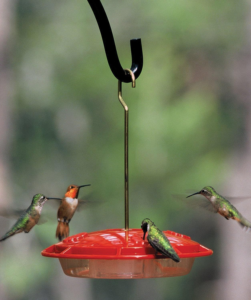 clean is the HummZinger Ultra 12‑oz Saucer Feeder. The saucer design makes it simple to see the nectar level at a glance and to reach every corner when you wash it, which is a big help during warm spells when nectar must be changed often. Its patented Nectar Guard tips are flexible membranes over each port that keep flying insects out while still allowing hummingbirds to feed freely, so you spend less time fighting bees and wasps around the feeder. A built‑in ant moat stops crawling insects before they reach the nectar, and the raised flower ports help divert rainwater so the nectar stays fresh longer.
Follow good feeder hygiene—use the 4‑to‑1 sugar‑water recipe and clean often—to keep birds healthy and complement your plantings. My step‑by‑step guide to cleaning your hummingbird feeder shows you exactly how to remove mold, how often to change nectar at different temperatures, and which brushes and ant moats make the job easier, plus tips for dealing with bees and ants so your feeders stay safe and attractive.
Provide safe perches and nesting cover
Keep some shrubs, small deciduous trees, and a few dead or thin branches where hummingbirds can rest, display, and build nests. Avoid pruning everything into neat, bare shapes; a slightly softer outline with twiggy tips gives birds more places to sit.
A hummingbird perch or swing is an easy way
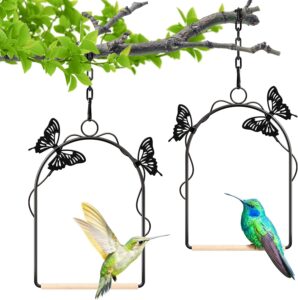
to bring hummingbirds to a particular spot near your feeder. Hummingbirds may look like they’re always in motion, but they actually spend a surprising amount of time sitting still between feeding bouts, using perches to rest, preen, digest nectar, and keep watch over their favorite food sources. A simple swing or decorative perch placed a few feet from your feeder gives them a comfortable “guard post” and brings them right into view where you can enjoy them up close. Many people find that once birds adopt a swing as their regular lookout perch, they stay in the yard longer and make more frequent, relaxed visits.
Offer water in a way hummingbirds like
Most people focus on feeders and flowers, but the right water feature can turn your yard into a hummingbird hangout. Hummingbirds prefer shallow, moving water—fine sprays, mists, and droplets on leaves—over deep, still birdbaths. Add a mister, dripper, or fine spray so hummingbirds can bathe in moving droplets on leaves or in a shallow basin.
Consider adding a mister to create a gentle cloud of moving water; 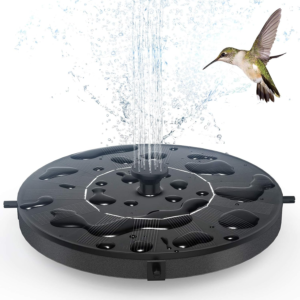 hummingbirds often fly back and forth through the mist, spreading their wings and tails to bathe without getting waterlogged. Place misters near shrubs or small trees so the droplets collect on leaves, giving birds multiple places to sip and bathe.
You can also install a shallow birdbath with gently sloping edges with gently sloping edges—no more than about an inch of water—gives hummingbirds a place to sip and splash at the edge.Position water features near, but not directly over, key flower beds so birds can move easily between bathing and feeding.
Skip pesticides and let insects thrive
-
Avoid or greatly limit pesticides, especially systemic insecticides, because hummingbirds and their chicks rely heavily on tiny insects and spiders for protein.
- A healthy, chemical‑free yard with native plants will naturally support more insects, which means more high‑quality food for hummingbirds.
This article Natural Pest Control Methods for Your Hummingbird Garden shows readers they don’t have to choose between a healthy hummingbird garden and effective pest control. It explains exactly how to prevent and manage pests using natural methods—companion planting, encouraging “good bugs,” organic sprays like garlic, pepper, and neem, physical barriers, and smart traps—so they protect their plants without poisoning hummingbirds or the insects they eat. It also gives clear, season‑by‑season checklists and safety tips (like where not to spray, how to avoid harming pollinators, and how to keep pest control away from nests and feeders), making it easy to follow even if you’re new to organic gardening. If you want fewer pests, stronger plants, and a garden that’s truly safe for hummingbirds from spring through fall, this is the article for you!
Keep Insects Away From Your Feeder
- Bees, wasps, and ant trails can quickly take over a hummingbird feeder, but you don’t have to give up and bring the feeder in. This guide How to Keep Bees and Ants Away From Your Hummingbird Feeder walks you through the safest, most effective ways to keep pests out of your nectar—using ant moats, bee‑resistant feeders, smarter placement, and even “decoy” feeders that draw insects away—so the sugar water stays clean and available for hummingbirds only. If you’re tired of fighting swarms on your feeders and want a simple plan that actually works, This guide is your proven answer!
Effective Tips For Pest Control At The Hummingbird Feeder
You will be lucky if ants, bees and wasps are the only pests that visit your hummingbird feeder. Here are steps you can take to control those much larger unwanted pests!
Kentucky Hummingbird FAQ
Q: What hummingbirds are found in Kentucky?
A: Ruby-throated Hummingbirds are the only regular breeding hummingbird species in Kentucky, although rare western vagrants can occasionally appear in late fall and winter.
Q: When do hummingbirds arrive and leave Kentucky?
A: Ruby-throated Hummingbirds typically arrive in Kentucky around early to mid‑April, nest through summer, and most have migrated south by late September.
Q: When should I put out hummingbird feeders in Kentucky?
A: Put feeders out by late March or very early April so they are ready for the first males, and leave at least one feeder up into early October in case of late migrants.
Q: What is the best nectar recipe for Kentucky hummingbirds?
A: Use 1 part plain white sugar to 4 parts water, boil and cool the mixture, and never add red dye, honey, or artificial sweeteners.
Q: How often should I clean hummingbird feeders in Kentucky?
A: In Kentucky’s warm weather, clean feeders and replace nectar every 2–3 days, and every day during hot spells, to prevent mold and fermentation.
Q: What flowers attract hummingbirds in Kentucky?
A: Native favorites include cardinal flower, eastern columbine, coral honeysuckle, wild bergamot, phlox, and jewelweed, along with many salvia and bee balm cultivars.
Q: Do hummingbirds stay in Kentucky over winter?
A: Ruby-throated Hummingbirds migrate to Central America for winter, but a few western species such as Rufous Hummingbirds are reported some winters and are considered rare visitors.
Q: Is it OK to leave hummingbird feeders up in fall in Kentucky?
A: Yes; leaving feeders up into October will not stop birds from migrating and can provide vital fuel for late migrants or rare winter visitors.
If you’re curious how your state compares to other parts of the country, you can see arrival and departure times for every state in my main guide, “When to Feed Hummingbirds: A State‑by‑State Guide.” It’s a handy overview if you travel, have relatives in other states, or just want to understand the bigger migration picture.
Kentucky “Expert Resources”
For Kentucky‑specific timing, feeder, and plant guidance, see “Kentucky Native Plants to Attract and Feed Hummingbirds” from the Kentucky Native Plant Society at https://www.knps.org/wp-content/uploads/2025/09/hummingbird-handout.pdf
and the Kentucky Hort News article “Attracting Hummingbirds” at https://kentuckyhortnews.com/2021/03/18/attracting-hummingbirds/.
For deeper plant ideas and native species you can highlight, use the KNPS blog post “Plant Opportunities to Attract Hummingbirds this Summer” at https://www.knps.org/plant-opportunities-to-attract-hummingbirds-this-summer/
and the broader native‑plant and habitat guidance in “Native Plants that Attract Hummingbirds” at https://www.backyardecology.net/hummingbird-plants/.