Connecticut: Attracting and Feeding Hummingbirds – A Complete Guide
Connecticut may be small, but it’s full of hummingbird action each spring and summer.
Ruby‑throated Hummingbirds return every year to gardens, woodland edges, and suburban yards across the state, bringing color and energy to New England landscapes.
This guide will help you know when hummingbirds arrive and leave Connecticut, how to feed them safely, and which native plants keep them coming back.
Key takeaways
-
Ruby‑throated Hummingbird is Connecticut’s only regular hummingbird species, with rare western visitors in some years.
-
Put feeders out in early to mid‑April and keep them up into early October.
-
Use a simple 4‑to‑1 sugar‑water nectar and avoid red dye.
-
Native, nectar‑rich plants like columbine, bee balm, and cardinal flower are excellent for Ruby‑throats in Connecticut.
What hummingbirds live in Connecticut?
For most backyard birders in Connecticut, there’s one main hummingbird to know: the Ruby‑throated Hummingbird.
-
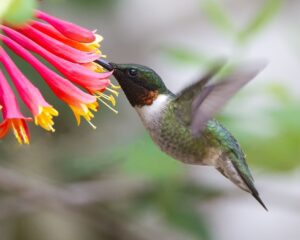
Ruby‑throated Hummingbird – Connecticut’s only regular, native hummingbird species. Males have a shimmering ruby throat and green back; females are green above and pale below. They breed across the state each summer.
-
Rufous Hummingbird and other western species – Rare but possible “vagrants,” most likely to show up in late fall or early winter at feeders, especially as unusual records.
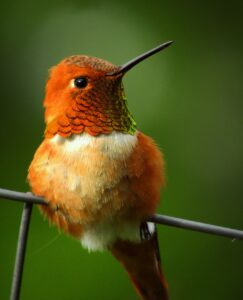
A lucky homeowner might occasionally see a Rufous in autumn.
When do hummingbirds visit Connecticut?
Connecticut hummingbirds are strictly seasonal.
They arrive in spring, stay for the breeding season, then head south before winter.
Typical timing:
-
Spring arrival – Ruby‑throated Hummingbirds usually begin arriving in Connecticut late April into May. Males often appear first at the end of April; females follow in May.
-
Summer nesting – Through June, July, and August, Ruby‑throats are busy nesting, feeding young, and visiting feeders and flowers across the state.
-
Fall migration and departure – Southbound migration ramps up late August through September, and most birds are gone by early October as they head toward the Gulf Coast, Central America, and Mexico.
Here is a simple rule:
-
Put feeders out by early–mid April so you’re ready for the first migrants.
-
Keep feeders up until at least early October, or about two weeks after you see your last hummingbird.
Best nectar recipe for Connecticut hummingbirds
The ideal hummingbird nectar recipe is the same in Connecticut as everywhere else.
Use this mix:
-
1 part white granulated sugar
-
4 parts clean water
Instructions:
-
Bring the water to a brief boil.
-
Stir in sugar until completely dissolved.
-
Let it cool to room temperature, then fill your feeders.
-
Store any extra nectar in the refrigerator for up to a week.
Important tips:
-
Do use only plain white table sugar (sucrose).
-
Do not use honey, brown sugar, raw sugar, or artificial sweeteners.
-
Do not add red dye; the feeder’s red parts are enough to attract birds.
How often to clean feeders in Connecticut
Connecticut summers can be warm and humid, which makes nectar spoil faster.
Cleaning schedule:
-
In cooler spring and fall weather, change nectar and clean feeders every 3–4 days.
-
In hot, humid summer weather, change nectar every 1–2 days to prevent mold and fermentation.
Cleaning steps:
-
Empty any leftover nectar.
-
Rinse thoroughly with warm or hot water.
-
Scrub all surfaces with a bottle brush; use a small brush for feeding ports.
-
For stubborn mold, soak in a mild vinegar‑and‑water solution (about 1:4), then rinse very well and let dry before refilling.
How to be sure your nectar is always fresh
It’s very important to keep fresh nectar in the feeder. Hummingbirds won’t feed at a dirty feeder and spoiled hummingbird nectar can be harmful to the hummingbirds. Sooner or later, the sugar in the nectar will ferment. The temperature of the outside air is what will determine how long the hummingbird food will stay fresh. The hotter the temperature, the sooner it will ferment and the sooner the nectar will have to be changed. Once the nectar starts to ferment it won’t be long before black specks of mold can be seen in the nectar and mold would be seen growing on your feeder. As a general rule, if the temp. is in the 60’s, the nectar should last about a week before needing changing. When the temp. gets out of the 60’s it will need changing sooner. Below is a chart that you can use as a guide to help keep your nectar fresh.
High temperatures…………Change nectar after
71-75……………………………6 days
76-80……………………………5 days
81-84……………………………4 days
85-88……………………………3 days
89-92……………………………2 days
93+………………………………change daily
This chart is only meant to be a general guide. It’s better to change the nectar a little sooner than to change it later, after the sugar starts to ferment. Along with the chart, a visual inspection of the nectar will tell you if it needs to be changed. Once the nectar starts to look cloudy, it needs to be changed. If it looks cloudy and has black specks of mold in it, you have waited too long. Moldy hummingbird food containing bacteria, can be harmful to the hummingbirds.
Where to hang hummingbird feeders in Connecticut
Good placement keeps hummingbirds safer and encourages frequent visits.
Helpful guidelines:
-
Choose partial shade or morning sun/afternoon shade to keep nectar from spoiling too quickly.
-
Hang feeders near flower beds, shrubs, or small trees, so birds can move easily between natural food and feeders.
-
Position feeders about 4–6 feet off the ground to deter predators and make cleaning easy.
-
Keep feeders a little away from very large windows to reduce the risk of collisions.
If one dominant male chases others away:
-
Try two or more small feeders instead of a single large one.
-
Place feeders out of direct line of sight of each other (around corners or on opposite sides of the yard).
- Here’s a great article that tells everything you need to know about how to choose the best place to hang your hummingbird feeder
For layered planting in Connecticut, feeders that are easy to clean, modest in size, and bug‑resistant work best around your flower beds.
What to look for in a feeder
-
Saucer (dish) design for easy cleaning and less leaking
Saucer‑style feeders are low‑profile, resist wind, rarely leak, and are among the easiest to scrub, which encourages frequent cleaning. -
Glass or high‑quality plastic you can see through
Glass reservoirs don’t warp or discolor, are easier to keep clean, and warm more slowly than thin plastic; either clear glass or clear plastic lets you see nectar levels and cloudiness. -
Bee guards and an ant moat
Raised, bee‑resistant ports plus a built‑in or add‑on ant moat keep insects out while your layered plantings draw lots of pollinators. -
Small–medium capacity (8–16 oz)
In Connecticut, a 12–16 oz feeder is ideal near your flower beds—you’ll want to change nectar every 1–3 days anyway, so huge “big gulp” feeders aren’t necessary unless you have heavy traffic. -
Perches at each port
Circular perches let hummingbirds rest while feeding and make it easier for you to watch them working your layered planting.- One of the best Hummingbird feeders that’s easy to take apart and clean is the HummZinger Ultra.
-

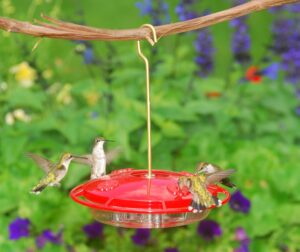
Hummzinger saucer Feeder The HummZinger Ultra12oz Saucer Feeder is one of the best options for a hummingbird feeder that’s both easy to clean and maintain. This top-tier feeder features patented Nectar Guard tips—flexible membranes on the feeding ports that keep flying insects out while still allowing hummingbirds to feed freely. Plus, it comes with an integrated ant moat to prevent crawling insects from reaching the nectar, and the raised flower ports help divert rain, keeping the nectar fresh.
How to use feeders with layered planting
- Hang one saucer‑style feeder at the outer edge of your layered bed (about 4–5 feet high), so birds can move naturally between columbine, bee balm, cardinal flower, and the feeder line.
- If you use two feeders, place the second 10–15 feet away or around a corner to reduce aggression, using the layered plants as cover between feeding stations.
Native plants that attract hummingbirds in Connecticut
Native plants are especially valuable in New England gardens.
They provide nectar, insects, and shelter that fit local climate and soils.
Perennials and wildflowers
- Wild columbine (Aquilegia canadensis) – early spring blooms that line up with arrival.
- Bee balm (Monarda didyma) – midsummer nectar favorite with showy red or pink blooms.
- Cardinal flower (Lobelia cardinalis) – brilliant red spikes in late summer that Ruby‑throats love.
- Anise hyssop (Agastache foeniculum) and other Agastache – fragrant spikes that attract hummingbirds and bees.
- Swamp milkweed (Asclepias incarnata) – good for both hummingbirds and monarch butterflies.
Vines and shrubs
- Trumpet honeysuckle (Lonicera sempervirens) – a non‑invasive, native honeysuckle with tubular flowers perfect for hummingbirds.
- Sweet pepperbush / summersweet (Clethra alnifolia) – Moisture‑tolerant New England native with fragrant summer blooms; specifically suggested by CT and regional wildlife/pollinator guides.
-
Buttonbush (Cephalanthus occidentalis) – Wet‑site native shrub with spherical summer flowers; listed in regional hummingbird‑plant lists and CT wildlife landscaping material.
-
Northern spicebush (Lindera benzoin) – CT native understory shrub; early flowers support insects, and foliage/structure offer cover in hummingbird‑friendly yards.
-
Serviceberry (Amelanchier spp.) – Native small tree/shrub in CT; spring bloom for insects, berries for birds, and good vertical structure near hummingbird beds.
-
Native azaleas / rhododendrons (regional species) – Included in CT pollinator and bird‑garden guidance as flowering shrubs that fit local woodlands and support insect life.
- Summersweet ‘Hummingbird’ (Clethra alnifolia ‘Hummingbird’) – Cultivar of a CT native specifically marketed in regional hummingbird plant lists.
NOTE: clustering these plants—rather than scattering single stems—creates richer nectar patches that hummingbirds can easily spot and work efficiently.
Creating a hummingbird‑friendly yard in Connecticut
Think of your yard as a small stopover station on a long migration route.
-
Layered planting – Combine low perennials, medium shrubs, and taller trees to offer feeding layers and perches.
-
Here are two concise, Connecticut‑specific layered planting examples:
Sunny/suburban border in Connecticut
In a sunny Connecticut border, you can create a three‑layer hummingbird strip along a 10‑ to 15‑foot fence. In the back layer, use small trees or tall shrubs like serviceberry or a compact eastern redbud, spaced about 6–8 feet apart for perches and light shade. In front of them, plant a middle row of flowering shrubs such as weigela or a native honeysuckle on a trellis, spaced 3–4 feet apart to form a nectar‑rich wall. Along the front edge, weave a low band of wild columbine, bee balm, and cardinal flower, planting every 18–24 inches so something is blooming from spring through early fall. This simple three‑row layout gives Ruby‑throated Hummingbirds cover, high lookout spots, and a continuous buffet of native flowers in a typical Connecticut yard.
Part‑shade woodland edge in Connecticut
Along a part‑shade woodland edge, you can still layer plants for hummingbirds. Let existing oaks, maples, or pines form the tall back layer for shelter and perches. Just in front, add medium shrubs like spicebush or mountain laurel, plus a run of trumpet honeysuckle on a fence or arch for tubular blooms. At the front, in the brighter strip, mass clumps of bee balm, anise hyssop, and coral bells, with patches of wild columbine near tree bases where spring light is strongest. This stepped transition from trees to shrubs to perennials fits New England’s wooded lots and gives hummingbirds safe cover plus nectar at several heights.
Plan for blooms from spring through fall
Include early, mid‑season, and late‑blooming plants so something is always flowering when hummingbirds are present in Connecticut. Plant in groups or drifts rather than single plants so hummingbirds can feed efficiently and find flowers more easily.
My special guide, The Art of Attracting Hummingbirds to Your Yard, gives you ready‑made lists of hummingbird‑attracting plants that bloom in spring, summer, and fall. It makes it simple to choose plants that keep nectar available from the time the first hummingbirds arrive until the last migrants leave in the fall, with suggestions for both sun and shade so you can match your own growing conditions.
Use feeders to supplement, not replace, flowers
Feeders are a great backup food source, especially during cold snaps or when natural blooms are between flushes. Hang them where they’re visible from flower beds so hummingbirds can move naturally between nectar plants and sugar water.
One of the best hummingbird feeders that’s easy to take apart and 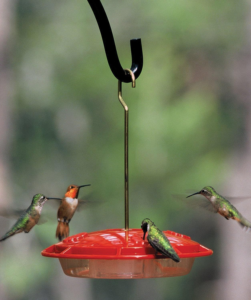 clean is the HummZinger Ultra 12‑oz Saucer Feeder. The saucer design makes it simple to see the nectar level at a glance and to reach every corner when you wash it, which is a big help during warm spells when nectar must be changed often. Its patented Nectar Guard tips are flexible membranes over each port that keep flying insects out while still allowing hummingbirds to feed freely, so you spend less time fighting bees and wasps around the feeder. A built‑in ant moat stops crawling insects before they reach the nectar, and the raised flower ports help divert rainwater so the nectar stays fresh longer.
Follow good feeder hygiene—use the 4‑to‑1 sugar‑water recipe and clean often—to keep birds healthy and complement your plantings. My step‑by‑step guide to cleaning your hummingbird feeder shows you exactly how to remove mold, how often to change nectar at different temperatures, and which brushes and ant moats make the job easier, plus tips for dealing with bees and ants so your feeders stay safe and attractive.
Provide safe perches and nesting cover
Keep some shrubs, small deciduous trees, and a few dead or thin branches where hummingbirds can rest, display, and build nests. Avoid pruning everything into neat, bare shapes; a slightly softer outline with twiggy tips gives birds more places to sit.
A hummingbird perch or swing is an easy way
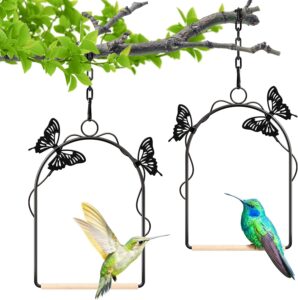
to bring hummingbirds to a particular spot near your feeder. Hummingbirds may look like they’re always in motion, but they actually spend a surprising amount of time sitting still between feeding bouts, using perches to rest, preen, digest nectar, and keep watch over their favorite food sources. A simple swing or decorative perch placed a few feet from your feeder gives them a comfortable “guard post” and brings them right into view where you can enjoy them up close. Many people find that once birds adopt a swing as their regular lookout perch, they stay in the yard longer and make more frequent, relaxed visits.
Avoid heavy pruning during nesting season and leave a few “messy” corners with twigs, lichens, and spider webs that birds use for nest building.
Offer water in a way hummingbirds like
Most people focus on feeders and flowers, but the right water feature can turn your yard into a hummingbird hangout. Hummingbirds prefer shallow, moving water—fine sprays, mists, and droplets on leaves—over deep, still birdbaths. Add a mister, dripper, or fine spray so hummingbirds can bathe in moving droplets on leaves or in a shallow basin.
Consider adding a mister to create a gentle cloud of moving water; hummingbirds often fly back and forth through the mist, spreading their wings and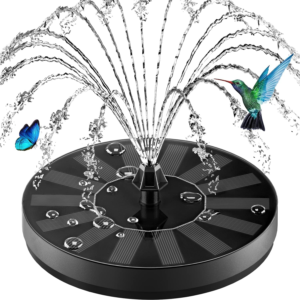 tails to bathe without getting waterlogged. Place misters near shrubs or small trees so the droplets collect on leaves, giving birds multiple places to sip and bathe.
You can also install a shallow birdbath with gently sloping edges with gently sloping edges—no more than about an inch of water—gives hummingbirds a place to sip and splash at the edge. Position water features near, but not directly over, key flower beds so birds can move easily between bathing and feeding.
Position water features near, but not directly over, key flower beds so birds can move easily between bathing and feeding.
My detailed guide, How to Use Water Features to Attract Hummingbirds, walks you through the exact kinds of misters, drippers, and shallow baths hummingbirds prefer, how deep and how strong the water flow should be, where to place everything so birds feel safe, and how to keep it all clean without spending a lot of money.
Skip pesticides and let insects thrive
-
Avoid or greatly limit pesticides, especially systemic insecticides, because hummingbirds and their chicks rely heavily on tiny insects and spiders for protein.
- A healthy, chemical‑free yard with native plants will naturally support more insects, which means more high‑quality food for hummingbirds.
This article Natural Pest Control Methods for Your Hummingbird Garden shows readers they don’t have to choose between a healthy hummingbird garden and effective pest control. It explains exactly how to prevent and manage pests using natural methods—companion planting, encouraging “good bugs,” organic sprays like garlic, pepper, and neem, physical barriers, and smart traps—so they protect their plants without poisoning hummingbirds or the insects they eat. It also gives clear, season‑by‑season checklists and safety tips (like where not to spray, how to avoid harming pollinators, and how to keep pest control away from nests and feeders), making it easy to follow even if you’re new to organic gardening. If you want fewer pests, stronger plants, and a garden that’s truly safe for hummingbirds from spring through fall, this is the article for you!
Keep Insects Away From Your Feeder
- Bees, wasps, and ant trails can quickly take over a hummingbird feeder, but you don’t have to give up and bring the feeder in. This guide How to Keep Bees and Ants Away From Your Hummingbird Feeder walks you through the safest, most effective ways to keep pests out of your nectar—using ant moats, bee‑resistant feeders, smarter placement, and even “decoy” feeders that draw insects away—so the sugar water stays clean and available for hummingbirds only. If you’re tired of fighting swarms on your feeders and want a simple plan that actually works, This guide is your proven answer!
Effective Tips For Pest Control At The Hummingbird Feeder
You will be lucky if ants, bees and wasps are the only pests that visit your hummingbird feeder. Here are steps you can take to control those much larger unwanted pests!
Common hummingbird questions in Connecticut
When should I put out hummingbird feeders in Connecticut?
Put feeders out by early to mid‑April so you’re ready for the first Ruby‑throated migrants arriving late April into May.
When do hummingbirds leave Connecticut?
Most Ruby‑throated Hummingbirds leave by late September, with many gone by early October as they migrate south to their wintering grounds.
Will keeping feeders up stop hummingbirds from migrating?
No. Migration is triggered mainly by changing day length, not feeder availability. Leaving feeders up into early fall actually helps late migrants and young birds refuel.
Are there hummingbirds here in winter?
Ruby‑throats are not regular winter residents in Connecticut, but a rare Rufous or other western hummingbird may appear occasionally in late fall or winter.
Connecticut “Expert Resources”
For Connecticut‑specific information on Ruby‑throated Hummingbird timing and behavior, you can reference “Discover When Hummingbirds Are Set to Flee Connecticut (and Where They Go)” at https://a-z-animals.com/blog/discover-when-hummingbirds-are-set-to-flee-connecticut-and-where-they-go/,
which summarizes arrival around late April–May and departure by early October, backed up by New England migration guidance such as “When to Put Out Hummingbird Feeders in New England” at https://mahoneysgarden.com/when-to-put-out-hummingbird-feeders-new-england/
and broader migration maps like https://empressofdirt.net/hummingbird-migration-map/.
For native plant and habitat recommendations that work well in Connecticut gardens, use Audubon Connecticut’s “Getting Started with Native Plants” at https://www.audubon.org/connecticut/news/getting-started-native-plants
and the CT DEEP brochure “Bring Wildlife to Your Yard with Native Plants” at https://portal.ct.gov/-/media/deep/wildlife/pdf_files/outreach/nativelandscapingsmallpdf.pdf, which highlight hummingbird‑friendly natives such as bee balm, bergamot, beardtongue, trumpet honeysuckle, and cardinal flower.