Key Takeaways: Virginia Creeper for Hummingbirds
-
Builds deep habitat, not nectar: Virginia creeper’s small flowers, caterpillar‑hosting foliage, berries, and dense cover support insects and birds that hummingbirds rely on for food and protection.
-
Tough native vine for the Northeast: Hardy roughly in USDA Zones 3–10, it thrives in sun or shade, climbs 30–50 feet on trees, fences, and walls, and delivers brilliant red fall color and bird‑loved berries.
-
Best as a backdrop to nectar vines: Use it to green and “wild up” fences, trees, and slopes behind high‑nectar vines like trumpet honeysuckle and crossvine, plus the hummingbird perennials from your Northeastern plant list.
Virginia Creeper: A Wildlife Workhorse Vine for Hummingbird Gardens
When gardeners think about vines for hummingbirds in the Northeastern United States, they usually picture bold, tubular blooms like trumpet honeysuckle / coral honeysuckle or trumpet creeper. Virginia creeper (Parthenocissus quinquefolia) looks different—five‑leaf clusters, small greenish flowers, and blue berries—but it quietly supports an enormous amount of wildlife.
Virginia creeper won’t be your primary nectar source for hummingbirds, but it absolutely belongs in a Northeastern hummingbird garden as a structural, wildlife‑rich vine that feeds insects, birds, and small animals, and provides dense cover and nesting sites. In other words, it’s the “infrastructure” that makes your showier hummingbird vines and flowers part of a real habitat instead of just decoration.
How Virginia Creeper Helps Hummingbirds
Virginia creeper is a native woody vine in the grape family (Vitaceae), found across much of eastern and central North America, including the entire Northeastern U.S. It climbs using tendrils tipped with adhesive pads, allowing it to cling strongly to bark, rock, and walls without twining tightly or strangling its support.
From a hummingbird perspective, its value comes mostly from indirect support:
-
Its small, greenish‑white flowers in late spring and summer provide nectar and pollen for bees and other small pollinators.
-
As a host plant, Virginia creeper supports numerous caterpillar species, including sphinx moths and other Lepidoptera, whose larvae become protein‑rich food for nesting birds.
-
Its dense foliage offers shelter and nesting sites for songbirds; cardinals, for example, are documented nesting in Virginia creeper on arbors and fences.
-
In fall, its blue‑black berries are eaten by many birds—sources note 30+ bird species using them—along with mammals like squirrels, chipmunks, and raccoons.
Hummingbirds rely on a constant supply of tiny insects and spiders for protein, especially when feeding young, and they thrive in gardens that support a robust insect and bird community. By hosting caterpillars and other insects and providing cover for small birds, Virginia creeper indirectly feeds and protects the hummingbirds working your more obvious nectar plants.
You may occasionally see hummingbirds investigate its flowers, but you should treat Virginia creeper primarily as a habitat vine that complements your true nectar vines and flowers, not as a direct replacement for them.
Native Range, Hardiness, and Growth Habit
Virginia creeper is native to a huge swath of eastern and central North America—from New England and the Mid‑Atlantic through the Midwest and South, and west into parts of the Plains and Rockies. That means it is fully at home in the Northeastern United States and already woven into local ecosystems.
Key stats:
-
Hardiness: Approximately USDA Zones 3–10, making it hardy throughout the Northeast and far beyond.
-
Height: 30–50 feet or more when given a suitable support.
-
Spread: Typically 5–10 feet, but can spread further along the ground as a groundcover.
-
Climbing method: Tendrils with adhesive pads that “glue” themselves to surfaces.
The vine is fast‑growing and vigorous. It can:
-
Climb tall trees, fences, and masonry walls.
-
Scramble along the ground as a dense groundcover, where it provides cover and nesting habitat for small animals.
-
Quickly cover banks and slopes, helping with erosion control.
In fall, Virginia creeper is especially striking, turning deep red, burgundy, or crimson, often before many other vines color up. The combination of red foliage and blue berries is visually dramatic and highly attractive to birds.
Flowers, Berries, and Wildlife
Flowers
Virginia creeper’s flowers are small and often overlooked, but they are ecologically important. They appear in clusters in late spring to early summer and are greenish‑white to yellowish.
-
Bees and other small pollinators visit the flowers for nectar and pollen.
-
Gardeners observing wildlife note bees, flies, and other insects using Virginia creeper blossoms heavily when in bloom.
Although the flowers aren’t classic hummingbird magnets like trumpet honeysuckle or crossvine, that insect activity gives hummingbirds extra hunting opportunities around the vine.
Berries
After flowering, Virginia creeper produces clusters of small, blue‑black berries on bright red stems, typically ripening in late summer into fall. These berries are:
-
Eaten by at least 30 bird species, including chickadees, robins, catbirds, woodpeckers, warblers, bluebirds, and others.
-
Used by mammals such as squirrels, chipmunks, opossums, raccoons, and deer, which also browse leaves and stems.
For your hummingbird garden, that bird traffic is a plus. More birds mean more insect‑control, more activity, and a richer experience overall. While the berries are not edible for humans (they are considered toxic to people), they are a major wildlife food in fall and early winter.
Cover and Nesting
Virginia creeper’s dense foliage and branching habit create excellent cover:
-
Birds nest in it when it grows over arbors, fences, and shrubs; Northern Cardinals are specifically documented nesting in Virginia creeper.
-
Small mammals and ground‑nesting birds use it as shelter when it sprawls along the ground or covers brush piles.
In a hummingbird planting, Virginia creeper is the vine that turns the back fence or a tree‑covered corner into a wildlife hub, so hummingbirds aren’t feeding in a sterile landscape but in a living, bird‑rich environment.
Growing Conditions and Site Selection
Virginia creeper is remarkably adaptable, which is part of why it’s such a useful vine in the Northeast.
Light
-
Thrives in full sun to part shade.
-
Tolerates full shade, though foliage will be less dense and fall color may be less intense; flowering and fruiting may also be reduced.
Soil
-
Grows in a wide range of soils: clay, loam, sand, and chalk.
-
Handles acidic, neutral, or slightly alkaline pH.
-
Prefers moist but well‑drained soil but tolerates periods of drought once established.
Hardiness
-
With hardiness from about Zone 3 to 10, Virginia creeper is entirely comfortable through Northeastern winters, from northern New England to the Mid‑Atlantic.
Because it’s so adaptable, you can use Virginia creeper in spots where more finicky hummingbird vines or shrubs might struggle: north‑facing fences, partial shade, tough clay banks, and edges of woodland where roots compete.
For sun‑drenched, prime hummingbird spots, you’ll still want nectar‑rich vines like trumpet honeysuckle and crossvine. Virginia creeper often shines just to the side of those, filling in less ideal but still valuable spaces.
Managing a Vigorous Native Vine
Virginia creeper is vigorous and can grow 30–50 feet or more, so you need to plan for its enthusiasm.
Climbing and Surfaces
-
It climbs via tendrils with adhesive pads that can stick strongly to masonry, wood, and even relatively smooth surfaces.
-
The pads do not penetrate the surface, but they can be very hard to remove cleanly; pulling them off may damage paint or leave marks on walls.
-
Because the vine is flammable and can hold dry leaves close to structures, some sources recommend keeping it away from the exterior walls of houses for fire safety.
Best supports:
-
Fences, arbors, pergolas, trellises, and free‑standing screens.
-
Large, mature trees (especially at woodland edges), where the vine can climb the trunk and branches without harming the tree.
-
Rock walls, old stumps, and banks, where it can function as a green (and then red) cloak.
Pruning and Control
Virginia creeper is easy to prune and can be cut back at almost any time to keep it in bounds.
-
Routine: Trim back unwanted shoots during the growing season to keep the vine from reaching gutters, windows, or roofs.
-
Structural: In late winter or early spring, you can do heavier thinning—removing older stems or reducing volume—to keep the framework manageable.
-
Along the ground: Mow or trim creeping runners if you don’t want it spreading across a lawn or into beds.
Because it’s a native and not invasive, the goal is not to eradicate it but to guide it: let it cover the supports you want and edit it where it overreaches.
Virginia Creeper vs. Other Hummingbird Vines
Virginia creeper plays a different role than your classic hummingbird vines:
-
Trumpet honeysuckle / coral honeysuckle (Lonicera sempervirens):
-
A compact, well‑behaved native vine with red tubular flowers that are top‑tier nectar for hummingbirds.
-
Best for smaller structures, railings, and arbors in prime sunny spots.
-
-
Crossvine (Bignonia capreolata):
-
A vigorous native with orange‑red trumpets and a huge spring bloom that hummingbirds love.
-
Needs a big, sturdy framework and is best in Zone 6+ Northeastern microclimates.
-
-
Trumpet vine (Campsis radicans):
-
Very vigorous native with large orange‑red trumpets, excellent for hummingbirds but often too aggressive in small yards.
-
-
Virginia creeper (Parthenocissus quinquefolia):
-
Not a top direct nectar source, but an outstanding habitat vine that hosts insects, feeds birds with berries, and provides cover across sun and shade.
-
Ideal for covering fences, trees, and tough spots, especially where you want to support birds and insects around your nectar vines.
-
A hummingbird‑focused, native‑heavy vine strategy in the Northeast might look like:
-
Trumpet honeysuckle as your primary nectar vine in smaller spaces.
-
Crossvine or trumpet vine (carefully) on one big structure if climate and space allow.
-
Virginia creeper as the “background” vine along fences, into trees, and over rough areas to create wildlife depth.
Design Ideas: Using Virginia Creeper in a Northeastern Hummingbird Garden
1. Wildlife Fence or Woodland Edge
On a back fence or at a woodland edge:
-
Let Virginia creeper cover most of the fence, creating a green wall that turns red in fall and provides berries and cover for birds.
-
On one section or an attached trellis, grow trumpet honeysuckle / coral honeysuckle or crossvine as your main hummingbird nectar vine.
-
In front of the fence line, plant hummingbird‑friendly shrubs from your Shrubs for Hummingbirds in the Northeast: Building a Layered Garden page—such as American hazelnut, serviceberry, chokeberry, ninebark, New Jersey tea, highbush blueberry, and buttonbush.
This gives you:
-
Vertical cover and berries from Virginia creeper.
-
Nectar from vines and shrubs.
-
Nesting and foraging habitat for birds and insects on multiple levels.
2. Tree‑Climbing Habitat Column
On the trunk of a mature tree near your hummingbird bed:
-
Allow Virginia creeper to climb the trunk and main limbs, creating a leafy column that turns red in fall and hosts insects and bird nests.
-
At the base of the tree, plant clumps of top hummingbird perennials from your Best Hummingbird Plants for Northeastern United States guide, such asbee balm, cardinal flower, wild bergamot, Indian pink, wild blue phlox, or great blue lobelia depending on light and moisture.
The tree + Virginia creeper column becomes a background wildlife engine; the perennials below provide the nectar show where you can see it.
3. Slope or Bank Stabilization with Habitat
On a sunny or partly shaded slope:
-
Let Virginia creeper act as a groundcover and bank stabilizer, carpeting the slope with foliage and providing cover for small mammals and ground‑nesting birds.
-
At the top and bottom of the slope, plant nectar‑rich beds with butterfly weed, fringeleaf wild petunia, sweet William, fire pink, royal catchfly, and rough blazing star.
This turns a problem area into a wildlife asset while still centering hummingbird nectar in accessible, visible spots.
FAQ: Virginia Creeper in Hummingbird‑Attracting Vine Plantings
Is Virginia creeper a good plant for hummingbirds?
Virginia creeper is not a top nectar vine like trumpet honeysuckle or crossvine, but it is an excellent supporting vine in a hummingbird garden. Its flowers feed pollinators, its foliage hosts caterpillars, and its berries and cover support birds and small wildlife.
Will Virginia creeper damage my trees or structures?
Virginia creeper uses adhesive‑tipped tendrils and does not girdle or strangle trees the way some vines can. It doesn’t usually harm masonry, but the adhesive pads can be hard to remove and may pull off paint or leave marks on certain surfaces. It’s best used on fences, arbors, rock walls, and trees rather than directly on house siding.
Is Virginia creeper invasive?
No. Virginia creeper is native to the eastern U.S., including the Northeast, and is not considered invasive. It is vigorous and can spread, so you’ll want to prune and edit it, but it plays a positive role in local ecosystems.
Are the berries or leaves poisonous?
The berries are an important food for birds and wildlife but are considered toxic to humans and can cause illness if eaten. Leaves and stems can also cause irritation in some people. Plant it where children and pets are unlikely to eat the fruit, and avoid confusing it with poison ivy (which has three leaflets, not five).
How does Virginia creeper compare to ivy?
Unlike English ivy, which is non‑native and invasive in many areas, Virginia creeper is native and supports local wildlife with flowers, berries, and caterpillars. If you want a wildlife‑friendly “ivy‑like” vine in the Northeast, Virginia creeper is the better choice.
If you found this article helpful please share it with your friends using the social bookmarking buttons on the left side of this page. Help everyone to increase their knowledge and enjoyment of feeding hummingbirds. Do it for the hummingbirds! It also helps my ranking so my information will be available to more people. The more people that see this vital information, the more the hummingbirds are helped. Thank for your help. The hummingbirds and I appreciate you very much!
A few additions that will make any garden more hummingbird friendly
Provide nesting materials like cotton or plant fibers. You can place these materials in suet cages or spread them around your garden.
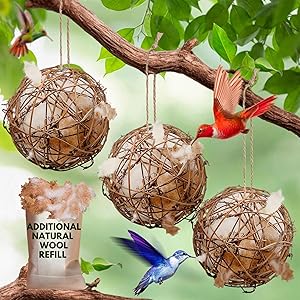
A major component of any successful hummingbird garden is a dependable hummingbird feeder that is easy to take apart and clean and doesn’t leak.
One of the best Hummingbird feeders that’s easy to take apart and clean is the HummZinger Ultra.
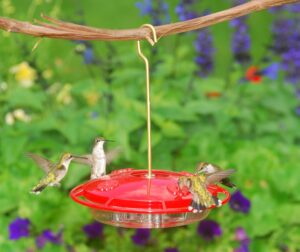
Aspects 12oz HummZinger Ultra With Nectar Guard.
The HummZinger Ultra 12oz Saucer Feeder is one of the best options for a hummingbird feeder that’s both easy to clean and maintain. This top-tier feeder features patented Nectar Guard tips—flexible membranes on the feeding ports that keep flying insects out while still allowing hummingbirds to feed freely. Plus, it comes with an integrated ant moat to prevent crawling insects from reaching the nectar, and the raised flower ports help divert rain, keeping the nectar fresh.
With a 12 oz capacity, this mid-size feeder offers plenty of space and can be hung or mounted on a post using the included hardware. It has four feeding ports and is made from durable, unbreakable polycarbonate. Whether you’re concerned about bees, wasps, or ants, this feeder is built for easy cleaning and insect protection.
If you already have a hummingbird feeder, and you want to protect it from ants and other crawling insects, the ant moat below will do the job.
Trap-It Ant Moat for Hummingbird Feeders
Using an ant moat for your hummingbird feeder is an effective way to keep ants away from the sweet nectar. These tiny creatures are drawn to
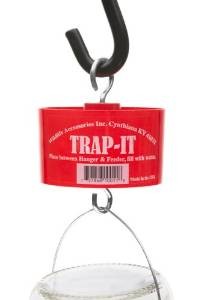
the sugar water, and without a barrier, they will quickly infest your feeder, preventing the birds from enjoying the nectar. An ant moat works by creating a barrier of water that ants can’t cross. Positioned above the feeder, it effectively blocks the ants’ path, keeping them from reaching the nectar.
This simple solution also ensures that your hummingbird feeder remains clean and accessible for the birds, rather than becoming a breeding ground for ants or other pests. It’s a small addition that can make a big difference in maintaining a healthy, inviting space for hummingbirds, while also reducing the need for chemical ant deterrents.
The first and still the best to protect your Hummingbird and Oriole feeder from ants and other crawling insects. Insert between hanger and feeder and fill with water, providing a barrier to crawling pests. Red color to attract hummingbirds.
In addition to nectar, hummingbirds need water and safe spaces to rest. By providing a birdbath or misting system, you can ensure they have everything they need.
Water Sources
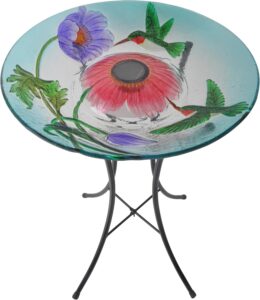
Hummingbirds enjoy fresh water to drink and bathe. A shallow birdbath with a fine spray from a mister is ideal. Just make sure the water is changed regularly to keep it clean.
Here’s a solar powered bird bath.
Hummingbird misters at Amazon.com
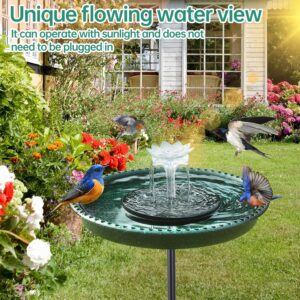
Install shallow bird baths with gently sloping edges. Hummingbirds prefer water sources that are no more than 1-1.5 inches deep.
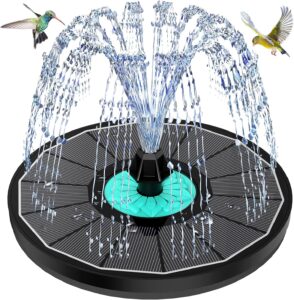
Consider adding a mister or dripper to create moving water, which attracts hummingbirds. They often enjoy flying through fine sprays of water.
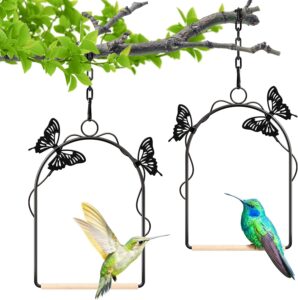
A hummingbird perch is a good way to attract hummingbirds to a particular spot near your feeder
Use Songbird Essentials Nectar Aid Self Measuring Pitcher and never measure ingredients again. Make any amount and the ingredients are measured for you.
 |
Column 2 |
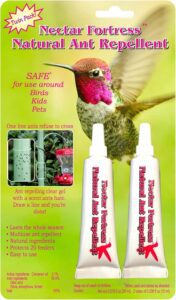
Nectar Fortress™ Natural Ant Repellent
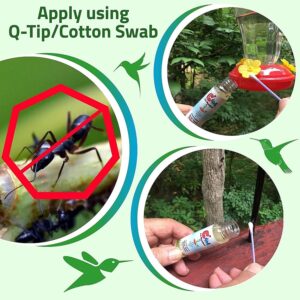
CREATED FOR HUMMINGBIRD FEEDERS: Stop ants fast and keep them away from the bird feeder altogether. Use it on poles or hooks and create a barrier with a scent ants hate. Useful with ant moats or eliminate the moat entirely.
C’ANT, Ant and Bee Repellent for Hummingbird Nectar Feeders and Outdoor Bird Seed Feeders – Works with Shepherds Hook and Ant Moat – 1 oz.
Hummingbird resources to help make your garden a success
Here’s a complete guide to attracting hummingbirds to your yard. It lists plants, vines and shrubs that are in bloom for spring, summer and fall. Your hummingbirds will always have flowers to feed on.
Here’s a great article that tells everything you need to know about how to choose the best place to hang your hummingbird feeder.
Here’s the best designed hummingbird feeder to use. It’s leak proof, so it won’t attract insects and it’s easy to take apart and clean.
Here’s a comprehensive guide to help you clean your hummingbird feeder for those times when the nectar is not changed soon enough and mold starts to grow.
More Hummingbird Resources
U.S. Fish and Wildlife Service – Hummingbird Conservation
This site offers detailed information about various hummingbird species, their habitats, and conservation efforts. It also provides resources on how to protect these fascinating birds.
National Park Service – Hummingbird Resources
The National Park Service offers insights into hummingbird species found in national parks, their behaviors, and their role in ecosystems, along with tips for observing them.
Smithsonian National Museum of Natural History – Birds: Hummingbirds
This resource provides educational materials on the role of hummingbirds in pollination and biodiversity, backed by scientific research and exhibits from the Smithsonian.