Key Takeaways: Crossvine for Hummingbirds
-
Early, nectar‑rich bloom: Crossvine’s yellow‑throated, orange‑red trumpet flowers open in mid‑ to late spring, providing an important early nectar source for Ruby‑throated Hummingbirds.
-
Big, native vertical accent: This native vine (hardy about USDA Zones 5–9, best in 6–9) can climb 30–50 feet on arbors, fences, and trees, creating a dramatic hummingbird beacon without the invasiveness of some non‑native vines.
-
Best with layered companions: Use crossvine on a sturdy structure and surround its base with native nectar plants from your Northeastern list—like bee balm, cardinal flower, and trumpet honeysuckle—to keep hummingbirds fed from early spring through fall.
If you want a vine that can stop traffic when it blooms and make hummingbirds slam on the brakes in midair, crossvine (Bignonia capreolata) deserves a serious look. Its clusters of orange to red, trumpet‑shaped flowers are packed with nectar, shaped for hummingbirds, and produced in such abundance that the whole plant can glow against a fence, arbor, or tree. Unlike aggressive non‑natives, crossvine is a native North American vine that supports wildlife and fits naturally into a hummingbird‑focused garden.
In this article, you’ll learn how crossvine helps hummingbirds, where it’s hardy, how to grow and manage it, and how to pair it with the shrubs and perennials you already use on your site—so it becomes a showpiece in a layered, native‑rich hummingbird habitat.
Why Crossvine is a Top Hummingbird Vine
Crossvine has all the classic features of a hummingbird‑adapted flower:
-
Long, tubular corolla that matches a hummingbird’s bill.
-
Bright orange, red, or red‑orange coloration with a contrasting yellow throat.
-
Abundant nectar and a heavy, concentrated bloom.
Wildlife and horticulture sources repeatedly call crossvine one of the best native vines for hummingbirds, and observers note Ruby‑throated Hummingbirds working the blooms intensively when the vine is in flower. It is often mentioned alongside trumpet honeysuckle (Lonicera sempervirens) and trumpet creeper (Campsis radicans) as a “big three” of tubular, red‑orange native hummingbird vines in the eastern U.S.
Where crossvine really shines is its timing and abundance:
-
In much of its core range, crossvine can begin blooming in early to mid‑spring, sometimes as early as March or April, providing very early nectar when hummingbirds are returning and other nectar sources are still limited.
-
The main flush is intense, with vines sometimes covered in clusters of flowers along the length of the stems.
-
Some selections repeat lightly later in the season, adding extra nectar beyond the main spring show.
For a Northeastern hummingbird garden, that early bloom helps bridge the gap before your herbaceous “superstars” like bee balm, wild bergamot, cardinal flower, and fire pink hit their stride.
Native Range, Hardiness, and Where It Fits in the Northeast
Crossvine is native primarily to the southeastern and south‑central United States, from Virginia and Maryland west to Kansas and south into Florida and Texas, often growing in woodlands, stream banks, and along fences or forest edges. It climbs by tendrils tipped with adhesive disks, allowing it to cling to bark, masonry, and other rough surfaces without needing to twine tightly around them.
Hardiness is usually listed as:
-
USDA Zones: roughly 5 or 6 through 9, depending on the source and cultivar, with most reliable information centering on Zones 6–9.
For the Northeastern United States, that means:
-
In Zone 6 areas (many parts of southern New England, southern New York, parts of Pennsylvania, New Jersey, and similar climates), crossvine can be a good fit if sited well (full sun, some wind protection, good drainage).
-
In colder Zone 5 sites and north, crossvine becomes more marginal; winter dieback and reduced flowering are more likely, and survival may depend heavily on microclimate and snow cover.
If you garden in a solid Zone 6 pocket of the Northeast and have a big, sturdy structure, crossvine can be a spectacular choice. In colder or more constrained gardens, trumpet honeysuckle / coral honeysuckle is usually the safer primary hummingbird vine, with crossvine as an optional “stretch” plant if you want to experiment in a warm, protected spot.
Growth Habit, Size, and Visual Impact
Crossvine is a vigorous, woody, semi‑evergreen to deciduous vine that can easily reach 30–50 feet in length under good conditions. In the South it can be nearly evergreen; in colder climates it will lose most or all of its leaves in winter and leaf out again in spring.
Key habit features:
-
Climbing method: Tendrils with tiny adhesive disks that latch onto rough surfaces—similar to Boston ivy or Virginia creeper.
-
Foliage: Opposite leaves; often 2 leaflets with a small tendril at the tip; some forms develop attractive reddish or bronzy winter foliage in milder climates.
-
Flowers: Clusters of tubular, flared trumpets in orange, red, or reddish‑yellow; many cultivars like ‘Tangerine Beauty’ have especially showy orange‑red blooms with yellow throats.
-
Fruit: Long, slender capsules after flowering that add some structural interest.
Visually, a mature crossvine in full bloom can create a wall of hummingbird color. It’s ideal on:
-
Strong arbors or pergolas.
-
Sturdy fences.
-
Large trellises.
-
The trunks of mature trees (especially at woodland edges), where it can scramble up and flower at eye level and above.
In a hummingbird garden, this makes crossvine a prime candidate for the “big vertical anchor” vine that birds can see from a distance and incorporate into their feeding circuit.
Wildlife Value Beyond Nectar
Crossvine is primarily grown for its hummingbird appeal and ornamental value, but like many native woody vines, it offers additional benefits.
-
Bees and other pollinators visit the blooms for nectar and pollen.
-
The dense foliage and twining habit provide cover and nesting opportunities for some birds and small wildlife, especially when grown on a trellis or over an arbor.
-
As a native vine, it integrates more comfortably into local ecosystems than non‑native vines like Japanese honeysuckle or invasive trumpet honeysuckle hybrids.
Crossvine is often recommended by Audubon and native‑plant groups as a native alternative to more aggressive or invasive vines, especially when gardeners want a bold, trumpet‑flower look for hummingbirds without resorting to non‑native species.
It doesn’t replace the deep insect‑hosting value of certain native shrubs, but as a nectar and structure vine in a mixed planting, it’s a very habitat‑friendly choice.
Growing Conditions and Care
Crossvine is vigorous, but it’s also relatively easy to manage if you plant it in the right spot and are comfortable pruning vines.
Light
-
Best: Full sun for the heaviest flowering and best growth.
-
Acceptable: Part sun (especially in hotter southern parts of its range), but too much shade reduces bloom.
For a Northeastern hummingbird garden, aim for full sun on the trellis or arbor where you plant crossvine, especially in cooler climates.
Soil
-
Prefers well‑drained, moderately fertile soil.
-
Tolerates a range of soil types, from sandy to clay, as long as drainage is decent.
-
Adapts to slightly acidic to slightly alkaline conditions.
Adding compost at planting helps with establishment, but crossvine doesn’t need heavy fertilization; too much nitrogen can push vegetative growth at the expense of flowers.
Water
-
Needs regular moisture during establishment (first 1–2 growing seasons).
-
Once established, it is fairly drought tolerant, though consistent moisture in spring helps maximize flowering.
Mulch around the base to conserve moisture and keep roots cool, but keep mulch a bit away from the main stems to prevent rot.
Pruning and Controlling Vigorous Growth
Crossvine is strong‑growing, which is great for quick coverage but means you need to be comfortable with a bit of pruning.
General rules:
-
Crossvine blooms on old wood—stems that formed the previous season.
-
Do major pruning right after the main spring bloom so you don’t remove next year’s flower buds.
-
Thin out or shorten long, wandering stems to keep the vine on its support and away from gutters, windows, or neighboring trees you don’t want it to climb.
Yearly maintenance:
-
Immediately after flowering, remove any dead or weak stems.
-
Cut back excessively long shoots to just above a strong bud or side branch.
-
If needed, remove some older stems near the base to encourage new flowering growth.
Compared to trumpet creeper, crossvine is usually considered less aggressive, especially in terms of suckering and underground spread, but it is still a big, enthusiastic vine. Plant it only where you genuinely want a large vertical feature.
Crossvine vs. Other Hummingbird Vines
You already feature trumpet honeysuckle / coral honeysuckle (Lonicera sempervirens) and trumpet vine (Campsis radicans) on your site. Crossvine fits between them in some useful ways:
-
Compared to trumpet honeysuckle:
-
Crossvine is bolder and more massive, with thicker stems and larger flowers, but less refined foliage.
-
Trumpet honeysuckle is generally better‑behaved in small gardens and in colder Northeastern climates, and it offers a long bloom season when sited well.
-
-
Compared to trumpet vine:
-
Crossvine is often considered the more controllable choice; trumpet vine can sucker aggressively and pop up yards away from where it was planted.
-
Both have large, bold tubular flowers and are excellent for hummingbirds; if you want a “trumpet‑vine look” with somewhat less fear of rampant spread, crossvine is a strong option.
-
A smart strategy in many Northeastern gardens is:
-
Make trumpet honeysuckle your primary hummingbird vine, especially in smaller yards.
-
Use crossvine on one substantial structure (like a big arbor or a fence run) where you want a “wow” spring display and can give it space.
-
Consider trumpet vine only where you truly have room and are comfortable managing its suckering.
Design Ideas: Crossvine in a Layered Hummingbird Garden
Here’s how you could integrate crossvine with the shrubs and perennials you already write about.
Big Arbor or Pergola Feature
If you have a sturdy arbor or pergola in a sunny spot:
-
Plant crossvine at one or two posts so it can quickly cover the structure, creating an orange‑red “roof” of bloom in spring.
-
At the base and around the structure, plant clumps of bee balm, wild bergamot, cardinal flower and great blue lobelia.
-
For early and woodland‑edge interest, tuck in eastern red columbine, Indian pink, or wild blue phlox.
As crossvine peaks in spring, hummingbirds will work the overhead flowers. As the season progresses, they’ll transition to the perennials around the base, keeping the arbor area active all season.
Fence or Property Line Screen
Along a sunny fence or property line:
-
Use crossvine on one strong section of fence as a vertical accent.
-
Back the fence line with hummingbird‑friendly shrubs from your Shrubs for Hummingbirds in the Northeast: Building a Layered Garden hub—such as American hazelnut, serviceberry, chokeberry, ninebark, New Jersey tea, highbush blueberry, and buttonbush where the soil is moist.
-
In front of that shrub row, mass perennials from your Best Hummingbird Plants for Northeastern United States page—butterfly weed, fringeleaf wild petunia, sweet William, rough blazing star, garden phlox, and more.
This creates a full vertical gradient: ground‑layer nectar, mid‑layer shrubs, and crossvine overhead—all usable by hummingbirds in different ways.
Crossvine in Small or Colder Northeastern Gardens
If you garden in a modest‑sized yard or a colder part of the Northeast:
-
Consider using crossvine on only one structure, and keep it pruned so it doesn’t overwhelm the space.
-
Choose a warm, protected microclimate—south‑facing wall, sheltered fence line, or near masonry that holds heat—to help crossvine through winter.
-
Treat it as an experiment alongside your more reliable native vine, trumpet honeysuckle, which is a safer bet for bloom and survival in colder zones.
Even if crossvine experiences some winter dieback in Zone 5–6 areas, it can resprout and still flower on new or partially overwintered stems, though the show may be reduced.
FAQ: Crossvine in Hummingbird Gardens
Is crossvine a good plant for hummingbirds?
Yes. Crossvine’s tubular, orange‑red flowers with yellow throats are classic hummingbird flowers and are widely recommended as a top native vine for Ruby‑throated Hummingbirds.
Is crossvine native to the Northeastern United States?
Crossvine is native mainly to the Southeast and south‑central U.S., but it can be grown successfully in parts of the Northeast where winters are mild enough (generally Zones 6–9) and where conditions suit it.
How hardy is crossvine?
Most sources list crossvine as hardy roughly in USDA Zones 5 or 6–9, with the most reliable performance in Zones 6–9. In colder Northeastern gardens, it may experience winter dieback or fail to bloom reliably.
How big does crossvine get?
Crossvine is a vigorous vine that can reach 30–50 feet long or more under good conditions, so it needs a strong support like a large trellis, arbor, fence, or mature tree.
Is crossvine invasive or too aggressive?
Crossvine is native and not considered invasive, but it is vigorous and can spread across a structure and into nearby trees if not managed. It is generally regarded as less troublesome than trumpet creeper but still requires regular pruning.
How should I prune crossvine for hummingbird gardens?
Prune right after the main spring bloom, thinning and shortening stems as needed to keep the vine on its support and to encourage fresh flowering wood for the next year. Avoid heavy pruning in late summer or winter, which will reduce bloom.
A few additions that will make any garden more hummingbird friendly
Provide nesting materials like cotton or plant fibers. You can place these materials in suet cages or spread them around your garden.
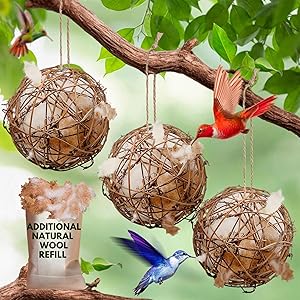
A major component of any successful hummingbird garden is a dependable hummingbird feeder that is easy to take apart and clean and doesn’t leak.
One of the best Hummingbird feeders that’s easy to take apart and clean is the HummZinger Ultra.
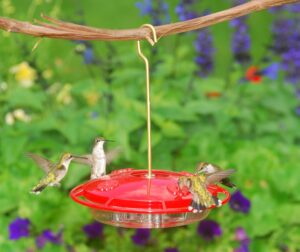
Aspects 12oz HummZinger Ultra With Nectar Guard.
The HummZinger Ultra 12oz Saucer Feeder is one of the best options for a hummingbird feeder that’s both easy to clean and maintain. This top-tier feeder features patented Nectar Guard tips—flexible membranes on the feeding ports that keep flying insects out while still allowing hummingbirds to feed freely. Plus, it comes with an integrated ant moat to prevent crawling insects from reaching the nectar, and the raised flower ports help divert rain, keeping the nectar fresh.
With a 12 oz capacity, this mid-size feeder offers plenty of space and can be hung or mounted on a post using the included hardware. It has four feeding ports and is made from durable, unbreakable polycarbonate. Whether you’re concerned about bees, wasps, or ants, this feeder is built for easy cleaning and insect protection.
If you already have a hummingbird feeder, and you want to protect it from ants and other crawling insects, the ant moat below will do the job.
Trap-It Ant Moat for Hummingbird Feeders
Using an ant moat for your hummingbird feeder is an effective way to keep ants away from the sweet nectar. These tiny creatures are drawn to
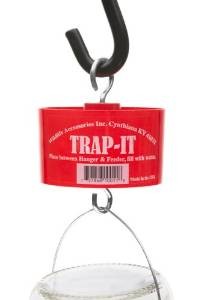
the sugar water, and without a barrier, they will quickly infest your feeder, preventing the birds from enjoying the nectar. An ant moat works by creating a barrier of water that ants can’t cross. Positioned above the feeder, it effectively blocks the ants’ path, keeping them from reaching the nectar.
This simple solution also ensures that your hummingbird feeder remains clean and accessible for the birds, rather than becoming a breeding ground for ants or other pests. It’s a small addition that can make a big difference in maintaining a healthy, inviting space for hummingbirds, while also reducing the need for chemical ant deterrents.
The first and still the best to protect your Hummingbird and Oriole feeder from ants and other crawling insects. Insert between hanger and feeder and fill with water, providing a barrier to crawling pests. Red color to attract hummingbirds.
In addition to nectar, hummingbirds need water and safe spaces to rest. By providing a birdbath or misting system, you can ensure they have everything they need.
Water Sources
Hummingbirds enjoy fresh water to drink and bathe. A shallow birdbath with a fine spray from a mister is ideal. Just make sure the water is changed regularly to keep it clean.
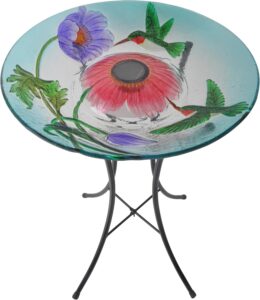
Here’s a solar powered bird bath.
Hummingbird misters at Amazon.com
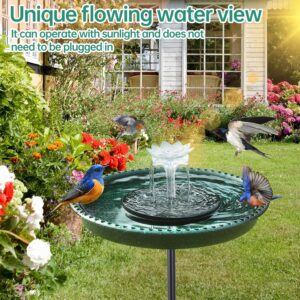
Install shallow bird baths with gently sloping edges. Hummingbirds prefer water sources that are no more than 1-1.5 inches deep.
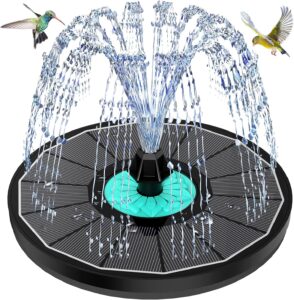
Consider adding a mister or dripper to create moving water, which attracts hummingbirds. They often enjoy flying through fine sprays of water.
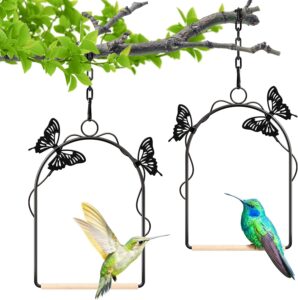
A hummingbird perch is a good way to attract hummingbirds to a particular spot near your feeder
Use Songbird Essentials Nectar Aid Self Measuring Pitcher and never measure ingredients again. Make any amount and the ingredients are measured for you.
 |
Column 2 |
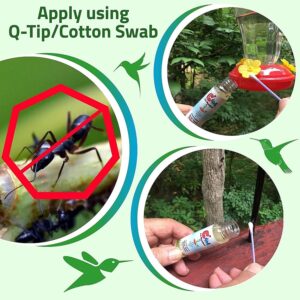
Nectar Fortress™ Natural Ant Repellent
CREATED FOR HUMMINGBIRD FEEDERS: Stop ants fast and keep them away from the bird feeder altogether. Use it on poles or hooks and create a barrier with a scent ants hate. Useful with ant moats or eliminate the moat entirely.
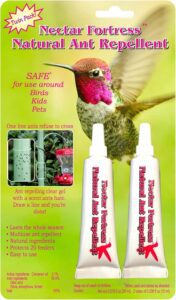
C’ANT, Ant and Bee Repellent for Hummingbird Nectar Feeders and Outdoor Bird Seed Feeders – Works with Shepherds Hook and Ant Moat – 1 oz.
Hummingbird resources to help make your garden a success
Here’s a complete guide to attracting hummingbirds to your yard. It lists plants, vines and shrubs that are in bloom for spring, summer and fall. Your hummingbirds will always have flowers to feed on.
Here’s a great article that tells everything you need to know about how to choose the best place to hang your hummingbird feeder.
Here’s the best designed hummingbird feeder to use. It’s leak proof, so it won’t attract insects and it’s easy to take apart and clean.
Here’s a comprehensive guide to help you clean your hummingbird feeder for those times when the nectar is not changed soon enough and mold starts to grow.
More Hummingbird Resources
U.S. Fish and Wildlife Service – Hummingbird Conservation
This site offers detailed information about various hummingbird species, their habitats, and conservation efforts. It also provides resources on how to protect these fascinating birds.
National Park Service – Hummingbird Resources
The National Park Service offers insights into hummingbird species found in national parks, their behaviors, and their role in ecosystems, along with tips for observing them.
Smithsonian National Museum of Natural History – Birds: Hummingbirds
This resource provides educational materials on the role of hummingbirds in pollination and biodiversity, backed by scientific research and exhibits from the Smithsonian.