The Calliope Hummingbird, Stellula calliope, is a very small hummingbird and the smallest bird found in Canada and the United States. It is the only member of the Stellula genus.
These birds have glossy green on the back and crown with white underparts. Their bill and tail are relatively short. The adult male has wine-red streaks on the throat, green flanks and a dark tail. Females and immatures have a pinkish wash on the flanks, dark streaks on the throat and a dark tail with white tips.
Their breeding habitat is open shrubby areas, usually at higher altitudes, in western North America from British Columbia south to Colorado and southern California. The female builds an open cup nest in a conifer under an overhanging branch.
They are migratory, generally leaving their breeding grounds earlier than most birds (although not as early as the Rufous Hummingbird) to take advantage of the late-summer wildflowers in the mountains of western North America. Most winter in western Mexico.
These birds feed on nectar from flowers using a long extendable tongue or catch insects on the wing. While collecting nectar, they also assist in plant pollination.
This bird was named after the Greek muse Calliope. The genus name means “little star”.
| Calliope Hummingbird Conservation status:Least concern |
||||||||||||||
|---|---|---|---|---|---|---|---|---|---|---|---|---|---|---|
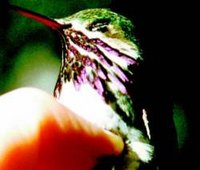 image is in the public domain.
|
||||||||||||||
| Scientific classification | ||||||||||||||
|
||||||||||||||
| Stellula calliope (Gould, 1847) |
Click Wikipedia, the free encyclopedia, to view original editable article – All text is available under the terms of the GNU Free Documentation License

