Wikipedia, the free encyclopedia, click to view original editable article – All text is available under the terms of the GNU Free Documentation License.
The Magnificent Hummingbird (Eugenes fulgens) is a large hummingbird that breeds in mountains from the southwestern United States to western Panama. It is the only member of the genus Eugenes, although the northern subspecies E. f. spectabilis has on occasion been separated from the larger nominate race of Costa Rica and Panama as Rivoli’s Hummingbird, E. spectabilis.
This bird inhabits the edges and clearings of montane oak forests from about 2000 m to the timberline. It is 13 cm long. The male weighs 10 g and the female 8.5 g. The black bill is long and slightly curved. Both sexes look very dark unless the sun catches the irridescence of the plumage and the brilliant colours flash in the sunlight.
The adult male has green-bronze upperparts, becoming more bronzed on the black-tipped tail. The crown is violet, the throat bright blue, and the rest of the head is black apart from a white spot behind the eye. The chest is green-bronze and the belly greyish.
The female Magnificent Hummingbird has bronze-green upperparts and dull grey underparts. There is a white stripe behind her eye. Immature birds are like the female, but darker and browner.
The female Magnificent Hummingbird is entirely responsible for nest building and incubation. She lays two white eggs in her bulky cup nest about 3 m up near the tip of a descending bamboo stem. Incubation takes 15-19 days, and fledging another 20-26.
The food of this species is nectar, taken from a variety of flowers, and some small insects. Magnificent Hummingbird males perch conspicuously and defend their feeding territories aggressively. The call of this species is a gutturaldrrrk.
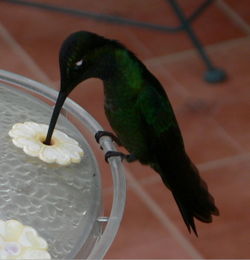
Permission is granted to copy, distribute and/or modify this image under the terms of the GNU Free Documentation License
| Kingdom: | Animalia |
| Phylum: | Chordata |
| Class: | Aves |
| Order: | Trochiliformes |
| Family: | Trochilidae |
| Genus: | Eugenes Gould, 1856 |
| Species: | E. fulgens |
Eugenes fulgens
(Swainson, 1827)
References
BirdLife International (2004). Eugenes fulgens. 2006 IUCN Red List of Threatened Species. IUCN 2006. Retrieved on 06 May 2006. Database entry includes justification for why this species is of least concern
Stiles and Skutch, A guide to the birds of Costa Rica ISBN 0-0814-9600-4
All text is available under the terms of the GNU Free Documentation License.
Wikipedia® is a registered trademark of the Wikimedia Foundation, Inc.

